

A sewage treatment plant (STP) in Bangalore must meet KSPCB standards of BOD ≤ 10 mg/L and TSS ≤ 10 mg/L for treated water reuse — significantly stricter than CPCB national minimums of BOD ≤ 30 mg/L. BBMP and BWSSB have additional requirements for residential projects and sewer connections. This guide covers everything a Bangalore developer, RWA, or building owner needs to know before making an STP decision.
Bangalore’s sewage treatment situation is unlike any other city in India. The combination of explosive high-rise development, one of the most actively enforcing SPCBs in the country, BWSSB connection requirements stricter than national norms, and a market flooded with cheap systems that fail within two years — makes the STP decision for a Bangalore project genuinely consequential.
We have been supplying STPs across Bangalore and Karnataka since 2013. In that time, we have seen the consequences when the decision goes wrong — housing societies with KSPCB notices, apartment complexes with systems producing 70 mg/L BOD against a 10 mg/L limit, IT parks with undersized systems overwhelmed by peak occupancy loads. We have also seen what happens when it goes right — buildings that commissioned a properly engineered system, got their CTO without a single inspection issue, and have been reusing treated water for flushing and landscaping for years without any maintenance drama.
This guide is the information you need to make the right decision the first time.
Why Sewage Treatment Is Non-Negotiable in Bangalore in 2026
Bangalore generates approximately 1,400 million litres of sewage per day. The city’s underground drainage network covers only a fraction of the urban area, and the Bruhat Bengaluru Mahanagara Palike (BBMP) has been steadily tightening enforcement on buildings that discharge untreated sewage — either into the network without on-site treatment or directly onto land.
For building owners and developers, the regulatory picture in 2026 looks like this:
- KSPCB (Karnataka State Pollution Control Board) issues Consent to Establish and Consent to Operate for all buildings generating sewage above defined thresholds — typically 50 residential units or 20,000 sq.m built-up area
- BWSSB (Bangalore Water Supply and Sewerage Board) requires buildings above certain sizes to treat sewage on-site before connection to the city sewer — the treated water quality standard is KSPCB’s reuse standard, not the more lenient CPCB general discharge standard
- BBMP building plan approvals for large residential projects increasingly require STP design documentation as part of the approval package
- NGT has issued enforcement orders against non-compliant buildings in Bangalore — penalties range from Rs. 5 lakh flat fines to Rs. 3 crore for complete non-installation
- KSPCB inspections of residential complexes, IT parks, and commercial buildings in Bangalore have increased significantly since 2023 — the enforcement is active, not theoretical
The enforcement pattern we see in Bangalore is different from most other cities. KSPCB here specifically checks outlet quality — not just whether an STP exists. A system that is running but producing BOD of 40 mg/L will fail a KSPCB inspection even though 40 mg/L meets CPCB national standards. Always design for KSPCB norms, not CPCB minimums
KSPCB vs CPCB — Understanding the Standards That Actually Apply in Bangalore
This is the most important thing to understand before specifying an STP for any Bangalore project — and it is the thing most STP suppliers in Bangalore either do not know or do not mention.
CPCB sets national minimum standards. KSPCB sets Karnataka-specific standards. When the two differ, KSPCB standards apply in Karnataka. For treated water reuse — which is what BWSSB requires for most Bangalore buildings connecting to the sewer — the gap is significant:
| Parameter | CPCB National Standard | KSPCB Karnataka Standard (Reuse) | Difference |
|---|---|---|---|
| BOD (mg/L) | ≤ 30 | ≤ 10 | 3x stricter |
| COD (mg/L) | ≤ 250 | ≤ 50 | 5x stricter |
| TSS (mg/L) | ≤ 100 | ≤ 10 | 10x stricter |
| Ammoniacal-N (mg/L) | ≤ 50 | ≤ 10 | 5x stricter |
| Fecal Coliform (MPN/100mL) | ≤ 1000 | ≤ 100 | 10x stricter |
A supplier quoting you a system to meet CPCB standards is giving you a system that will fail KSPCB inspection. This distinction alone is why so many Bangalore projects end up with systems that are technically functional but not compliant. Always ask your supplier specifically: what outlet quality does your system achieve at KSPCB reuse standard — BOD ≤ 10, TSS ≤ 10?
What Type of Bangalore Project Needs an STP — and When Does It Become Mandatory?
The threshold question comes up on almost every project. Here is what the current regulatory framework says:
| Project Type | STP Mandatory When | Authority |
|---|---|---|
| 50+ units or built-up area above 20,000 sq.m | KSPCB / BBMP | |
| Generating 10+ KLD sewage | KSPCB | |
| Generating 10+ KLD sewage | KSPCB / Tourism Dept | |
| Any size — biomedical waste rules apply | KSPCB / MoEFCC | |
| Generating 10+ KLD sewage | KSPCB / BBMP | |
| Generating 10+ KLD sewage | KSPCB / BBMP | |
| Any industrial effluent generation | KSPCB — ETP required |
Note that BWSSB has additional requirements beyond KSPCB for buildings connecting to the city sewerage network. Even if your project falls below the KSPCB threshold, BWSSB may still require on-site treatment as a condition of sewage connection. Check BWSSB requirements specific to your zone and building size before finalising your STP decision.
How to Size an STP for a Bangalore Project — The Calculation That Matters
Undersizing is the single biggest cause of STP failure and compliance problems in Bangalore. It is also the easiest mistake to avoid — if you use the right calculation.
The mistake most developers make is using the approved unit count rather than actual expected occupancy. A 200-unit apartment with 3.5 average occupants per unit at 80% occupancy generates 56 KLD — not the 20 KLD that a consultant estimating 100 LPCD for 200 units would produce. That 36 KLD gap means a catastrophically overloaded system from day one.
The correct calculation for Bangalore residential projects:
- Use 135 LPCD (litres per capita per day) as your design flow — this is the CPHEEO standard for residential domestic sewage
- Multiply by peak occupancy — not approved units, not average occupancy, but your realistic peak. For most Bangalore apartments this is approximately 3 to 4 persons per unit at 85 to 90% occupancy
- Add 20 to 25% safety margin for peak hour surge and future growth
- Verify against BWSSB requirements for your zone — some zones have specific minimum STP capacities for buildings above certain floor areas
Example: 150-unit apartment, 3.5 occupants per unit, 85% occupancy = 150 x 3.5 x 0.85 x 135 = 60,413 litres per day = approximately 60 KLD. Add 20% safety margin — size for 72 KLD minimum. Many consultants would size this at 20 to 25 KLD using conservative assumptions. The resulting system is immediately overloaded and produces non-compliant effluent from commissioning day.
For commercial projects — IT parks, hotels, hospitals — the calculation uses different LPCD benchmarks. Use 45 LPCD for office use without canteen, 60 LPCD with canteen, 80 LPCD for full food court campuses. Use our STP capacity calculator at susbio.in/how-to-calculate-sewage-treatment-plant-capacity/ for an accurate project-specific estimate.
The KSPCB CTE and CTO Process for Bangalore Projects
Every building above the mandatory threshold needs Consent to Establish (CTE) before construction and Consent to Operate (CTO) after commissioning. Both require KSPCB submission and approval. Here is what each involves:
Consent to Establish (CTE)
- Design Basis Report — capacity calculations, technology selection justification, organic loading analysis
- Process Flow Diagram — showing all treatment stages from inlet to outlet
- Site plan showing STP location within the building premises
- Equipment list with technical specifications
- Effluent disposal plan — where treated water will go (reuse for flushing, irrigation, or to BWSSB sewer)
- Environmental Impact Assessment if applicable to project scale
Consent to Operate (CTO)
- Installation completion certificate
- Performance test results — minimum 3 to 7 consecutive days of outlet samples demonstrating KSPCB-compliant quality
- OCEMS integration proof for Red Category industries and certain large installations
- Operator training certificate
KSPCB in Karnataka has specific expectations for what a Design Basis Report should contain — and their inspectors are trained to identify documents that are generic templates versus site-specific engineering work. We have been preparing CTE documentation for Karnataka projects since 2013 and we know what KSPCB Bangalore office looks for. Generic template documents get sent back for revision. A properly prepared DBR gets approved.
Common Reasons STP Projects Fail in Bangalore — What We See Every Year
After 500+ STP installations across India, including a significant number in Bangalore and Karnataka, the failure patterns repeat. Here are the most common ones we are called to fix:
Wrong outlet standard
The system was designed to CPCB general standards — BOD 30, TSS 100. KSPCB requires BOD 10, TSS 10. The system passes national norms but fails every Karnataka inspection. This is the most common failure pattern we see in Bangalore.
Severe undersizing
The system was sized for the minimum threshold — say 50 units — when the building at full occupancy has 200 residents generating 27 KLD. A 10 KLD system runs at 270% of design load from day one and never stabilises biologically.
No equalization tank or undersized equalization
Bangalore residential apartments have intense morning and evening sewage peaks. Without an adequately sized equalization tank, the biological reactor gets hydraulic shock loads that wash out the biomass and destroy treatment performance. Many systems skip or undersize the EQ tank to cut cost.
Civil STP built by general contractor without specialist input
We have been called to inspect civil STPs where the settling tank was built at the wrong depth, the aeration system was incorrectly specified, and the system was never properly commissioned with seed sludge. The result is a structure that looks like an STP but has never treated anything.
No post-commissioning maintenance
A biological STP is a living system. It needs regular screen cleaning, blower checks, water quality testing, and periodic sludge removal. Systems that run without maintenance for six to twelve months develop sludge bulking, screen blockages, and mechanical failures. The treatment quality deteriorates progressively and by the time KSPCB inspects, the outlet quality can be worse than the inlet.
Choosing the Right STP for Your Bangalore Project
The technology decision matters — but it matters less than the sizing, the outlet quality specification, and the quality of the commissioning and ongoing maintenance. Here is a practical guide to the decision:
| Project Type | Recommended Technology | Why |
|---|---|---|
| Residential apartment (50–200 units) | Packaged MBBR + Anaerobic FRP | Handles peak load variation, compact, KSPCB compliant outlet |
| Large residential complex (200+ units) | Packaged MBBR or SBR | Scalable, consistent quality at higher volumes |
| Boutique hotel (under 100 rooms) | Packaged MBBR + grease trap | Handles high-BOD kitchen effluent, compact |
| Large hotel or resort | MBBR or SBR with DAF pre-treatment | Variable occupancy tolerance, kitchen effluent management |
| Hospital or clinic | Packaged MBBR — hospital specification | Handles disinfectants and pharmaceutical residues |
| IT park or commercial campus | SBR or large MBBR | Variable flow tolerance for shift-pattern occupancy |
| Industrial facility | Site-specific ETP design | Process effluent requires characterisation before design |
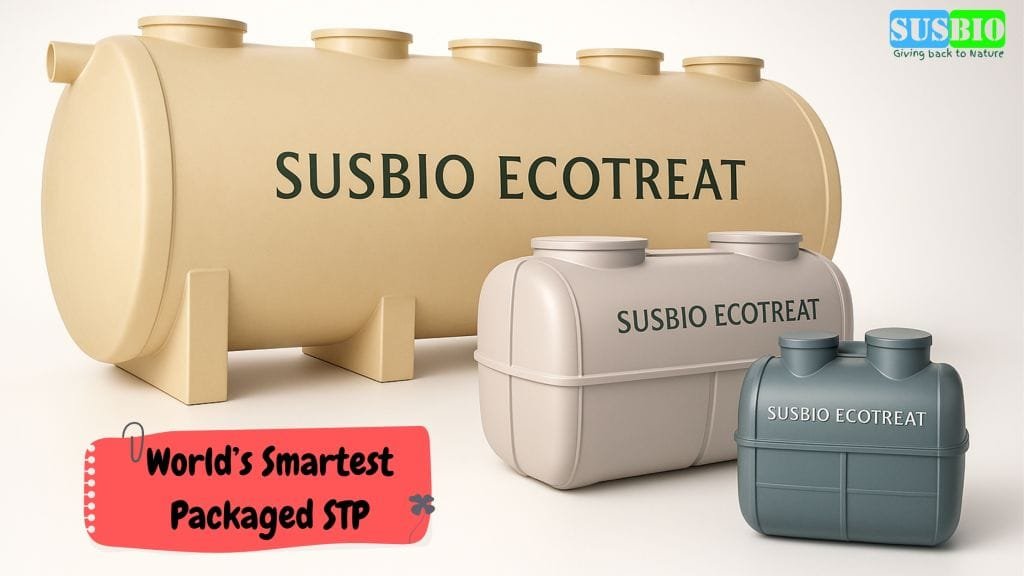
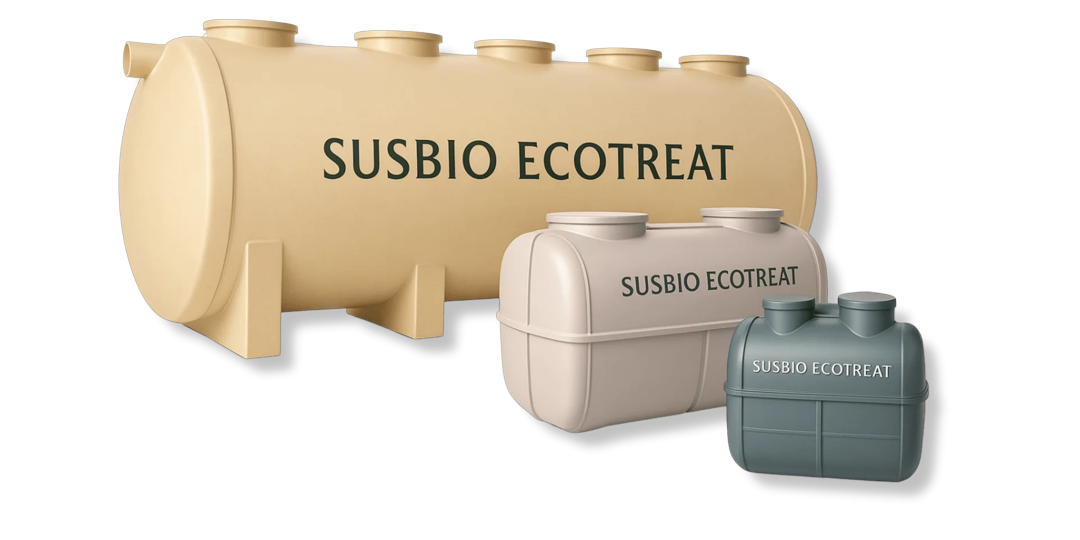
For most Bangalore residential and commercial projects, a factory-fabricated packaged STP — specifically MBBR + Anaerobic technology in an FRP vessel — is the right choice. It arrives tested, installs in days rather than months, consistently achieves KSPCB outlet standards, and requires less operator skill than civil alternatives. For Bangalore projects where BBMP occupancy certificate timelines are already tight, the installation speed advantage alone often justifies the choice. For the leading packaged STP, WTP and ETP manufacturer serving Bangalore — see SUSBIO’s Bangalore solutions page at susbio.in/top-stp-wtp-etp-manufacturers-in-bangalore/
STP Operating Costs in Bangalore — What to Budget
Capital cost is only part of the picture. A properly sized 50 KLD STP running in Bangalore will have the following annual operating costs as a realistic guide:
| Cost Category | Annual Estimate (50 KLD system) | Notes |
|---|---|---|
| Electricity | Rs. 1.2 – 2.0 Lakhs | Dominant cost — aeration blowers and pumps |
| Annual Maintenance Contract | Rs. 60,000 – 1.2 Lakhs | Depends on system complexity and supplier |
| Sludge disposal | Rs. 30,000 – 60,000 | Quarterly or bi-annual depending on loading |
| Chemicals (disinfectants, pH) | Rs. 15,000 – 30,000 | Routine consumables |
| Water quality testing (KSPCB compliance) | Rs. 20,000 – 40,000 | Quarterly testing recommended |
| Total annual OPEX estimate | Rs. 2.25 – 4.3 Lakhs | For a properly maintained 50 KLD system |
For context — a 50 KLD system producing 45 KLD of reuse-quality treated water saves approximately 16,425 KL of freshwater annually. At BWSSB commercial tariff rates, that is a water saving of Rs. 3 to 5 lakhs per year depending on the building’s water consumption pattern. The operating cost and the savings are in the same range — meaning a properly used STP pays for its operating cost in water savings alone.
Frequently Asked Questions — Sewage Treatment Plants in Bangalore
Q1. What is the KSPCB outlet standard for STPs in Bangalore?
KSPCB requires BOD ≤ 10 mg/L, COD ≤ 50 mg/L, TSS ≤ 10 mg/L, pH 6.5–8.5, and fecal coliform ≤ 100 MPN/100 mL for treated water reuse. These are significantly stricter than CPCB national general discharge standards and apply to most Bangalore projects, particularly for BWSSB sewer connection. Always specify your STP to KSPCB reuse standards, not CPCB minimums.
Q2. Is an STP mandatory for my apartment project in Bangalore?
Yes, for projects generating sewage above the regulatory threshold — typically 50 units or built-up area above 20,000 sq.m under KSPCB norms, and potentially lower thresholds under BBMP building regulations or BWSSB sewer connection requirements. The specific threshold for your project depends on its location and size within Bangalore. Contact SUSBIO to confirm the applicable requirements for your specific project.
Q3. How much does an STP cost for a 100-unit apartment in Bangalore?
A 100-unit apartment at typical Bangalore occupancy (3.5 persons per unit, 85% occupancy) generates approximately 40 KLD of sewage. A properly engineered packaged STP at 40 to 50 KLD capacity — supply, installation, and commissioning — typically costs Rs. 15 to 22 lakhs depending on site conditions, civil scope, and KSPCB documentation requirements. This includes KSPCB CTE and CTO documentation support. Contact SUSBIO at susbio.in/contact-us/ for a project-specific quotation.
Q4. What is the difference between KSPCB and CPCB standards for STPs?
CPCB sets national minimum discharge standards — BOD ≤ 30 mg/L, TSS ≤ 100 mg/L. KSPCB sets Karnataka-specific standards which for reuse applications are BOD ≤ 10 mg/L and TSS ≤ 10 mg/L — three to ten times stricter than CPCB minimums. In Karnataka, KSPCB standards apply and KSPCB inspectors check outlet quality against Karnataka standards. A system meeting CPCB minimums but not KSPCB reuse standards will fail a KSPCB inspection in Bangalore.
Q5. How long does it take to get KSPCB CTO for a Bangalore STP?
After installation and commissioning, Consent to Operate (CTO) requires submission of performance test results demonstrating KSPCB-compliant outlet quality over 3 to 7 consecutive days, plus installation documentation. Processing time at KSPCB Bangalore office typically ranges from 4 to 12 weeks depending on application completeness and current workload. A properly prepared application with all required documentation is processed faster. SUSBIO prepares complete CTO application documentation for every Bangalore project.
Q6. Can I use the treated water from my apartment STP for flushing?
Yes — and in Bangalore this is not just permitted, it is increasingly expected. BWSSB’s dual plumbing mandate for new large buildings requires separate plumbing for treated water reuse. Tertiary-treated water meeting KSPCB Class A standards — BOD ≤ 10, TSS ≤ 10, fecal coliform ≤ 100 — can be safely used for toilet flushing, landscape irrigation, and common area cleaning. A 50-unit apartment reusing treated water for flushing typically reduces potable water consumption by 25 to 35%, with corresponding water bill savings.
Q7. What happens if my Bangalore building’s STP fails KSPCB inspection?
A KSPCB inspection finding triggers a Show Cause Notice requiring corrective action within typically 30 days. Continued non-compliance leads to financial penalties — documented Bangalore cases include flat Rs. 5 lakh penalties per RWA regardless of building size, and penalties up to Rs. 3 crore for complete non-installation. KSPCB can also cancel the Consent to Operate, which prevents legal operation of the building’s sewage system. NGT has intervened in Bangalore cases with direct orders and financial penalties beyond the KSPCB penalty structure. The most effective protection is a properly designed, properly commissioned, and properly maintained STP.
Next Step — Get a Free Consultation for Your Bangalore Project
If you are making an STP decision for a Bangalore apartment, commercial building, hotel, hospital, or industrial facility — the most useful thing you can do before talking to any supplier is understand your actual sewage generation, your applicable KSPCB requirements, and your BWSSB connection obligations.
SUSBIO provides free technical consultations for Bangalore projects — including capacity assessment, KSPCB requirement confirmation, technology recommendation, and indicative budgetary proposal. No commitment required.
For SUSBIO’s complete range of packaged STP, WTP and ETP solutions for Bangalore — including detailed product specifications, capacity options, and project references — visit our Bangalore solutions page:
SUSBIO Bangalore STP, WTP and ETP Solutions: Top STP, WTP & ETP Manufacturer in Bangalore | Contact: +91 88889 80197 | info@susbio.in | Get a Free Consultation