

You have been told your project needs a sewage treatment plant. You have received three quotes. One is a civil STP — RCC tanks, a pump room, four months of construction, and a bill that is mostly concrete and labour. Another is a ‘packaged FRP unit’ arriving on a truck, ready to run in a week. The third is something called a ‘compact MBBR system’ from a manufacturer you cannot find online.
Which do you choose? More importantly — how do you know which packaged STP is genuinely engineered, CPCB-compliant, and built to last? And what makes a packaged STP fundamentally different from a civil one?
This guide answers all of it — from the engineering basics of what makes a packaged STP work, to a detailed cost comparison with civil systems, to the 10-point checklist you need before signing any purchase order. Updated for 2026 with real cost benchmarks and current CPCB compliance requirements.
What Is a Packaged STP?
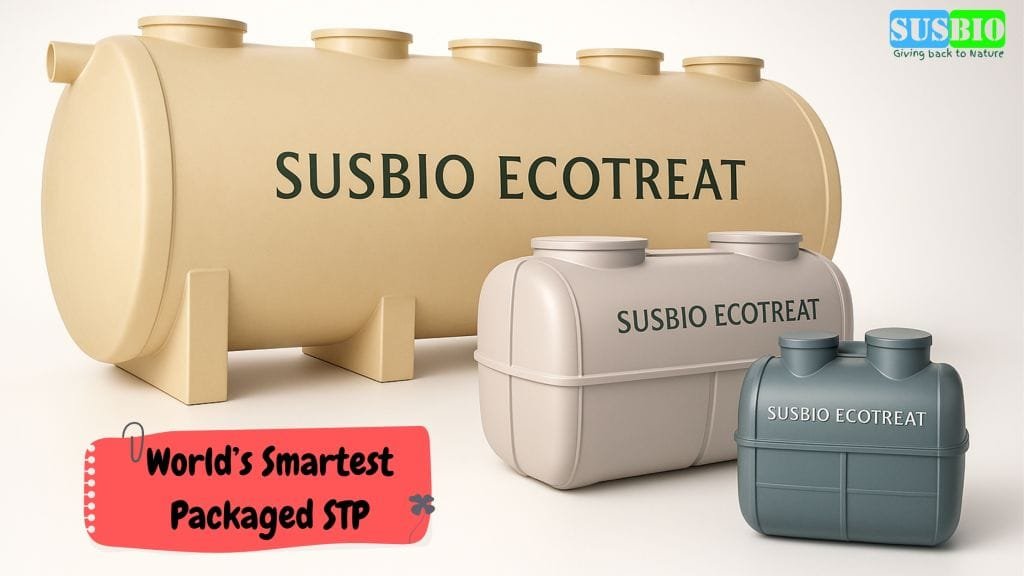
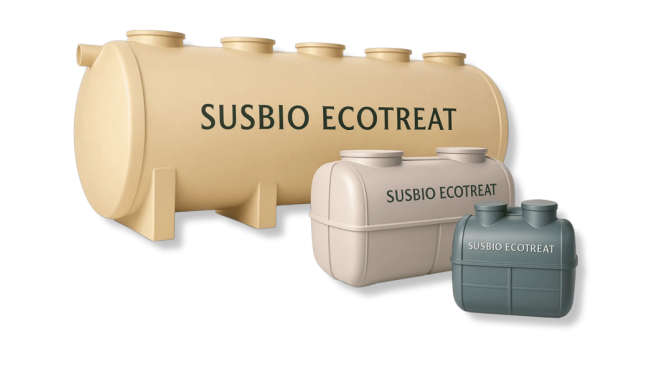
A packaged sewage treatment plant is a factory-manufactured, pre-engineered wastewater treatment system delivered to site as a complete unit — ready to install in days, with no on-site civil construction required. Unlike a civil STP (built from RCC tanks by a local contractor), every packaged STP is assembled under controlled factory conditions, tested before dispatch, and certified to CPCB standards. For building projects in the 2–500 KLD range, a packaged STP almost always offers faster installation, lower total cost, and more consistent performance than a site-built civil alternative
1. What Is a Packaged STP — And How Is It Different From a Civil STP?
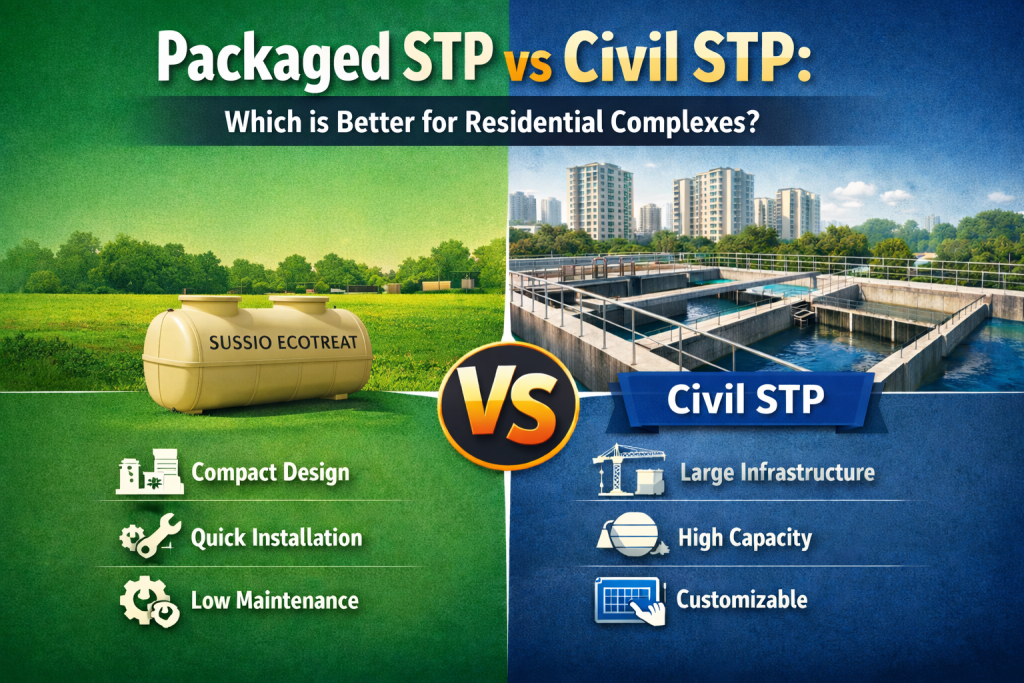
A packaged STP (also called a prefabricated STP) is a self-contained sewage treatment system where all treatment chambers, aeration equipment, biological media, control panel, and piping are integrated into a factory-built vessel — typically made of Fibre Reinforced Plastic (FRP). The entire system is manufactured offsite, pressure-tested, and dispatched ready for installation.
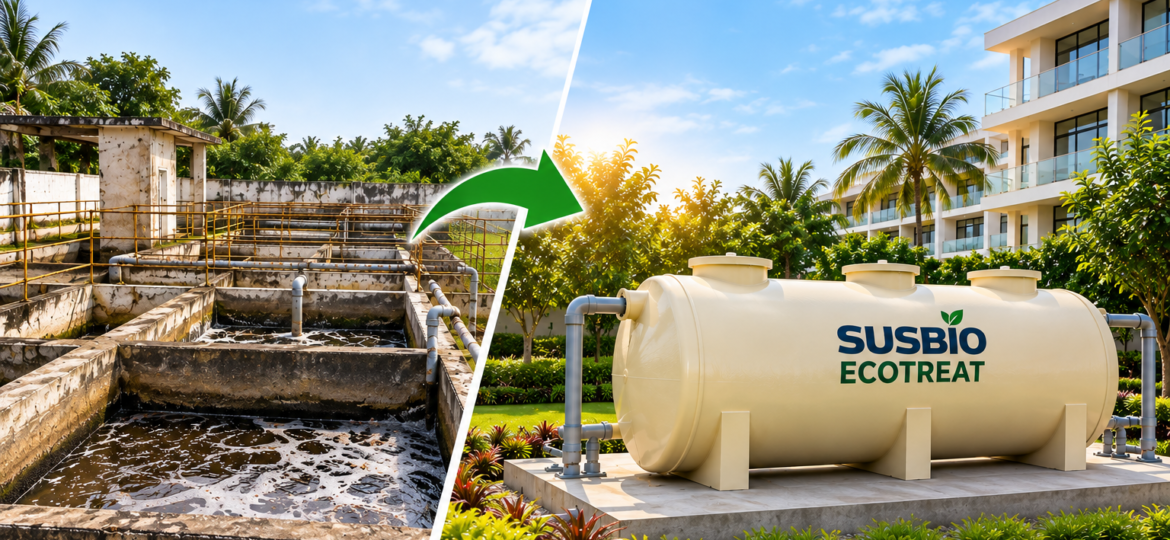
A civil STP (also called a conventional or RCC STP) is constructed on-site by local contractors. Separate tanks are built from reinforced concrete — a collection chamber, aeration tank, secondary clarifier, sludge sump — and then fitted with separately purchased equipment. The treatment process is the same in theory; the difference is entirely in how the system is built and what quality you can expect from the output.
| Factor | Civil STP (RCC, on-site) | Packaged STP (FRP, factory-built) |
|---|---|---|
| Installation time | 3–6 months for civil construction + equipment fitting | 3–7 days from site readiness to commissioning |
| Civil work required | Full RCC excavation, shuttering, curing, waterproofing | Only a levelled RCC plinth or pad needed |
| Footprint | Large — multiple separate tanks across a wide area | 40% less space — single integrated vessel |
| Quality control | Depends on local contractor skill — highly variable | Factory QC with pressure testing before dispatch — consistent every unit |
| CPCB compliance | Depends on design, construction quality, and ongoing O&M | Product-level CPCB approval on each unit (if from a reputable manufacturer) |
| Energy consumption | High — extended aeration typically 2–4 kWh per KL treated | Low — Anaerobic + MBBR design cuts energy by 70–90% |
| Operator requirement | Full-time operator needed in most states for civil STP | Fully automated — no on-site operator required |
| Effluent quality | BOD 20–40 mg/L typical from site-built systems | BOD < 10 mg/L from quality packaged Anaerobic + MBBR systems |
| Odour control | Open tanks create odour risk — common complaint issue | Closed FRP vessel — zero odour in correctly designed packaged STP |
| Sludge generation | High sludge from extended aeration systems | 60–70% less sludge from Anaerobic pre-treatment stage |
| Installation mode | Above-ground civil only | Above-ground or underground — both possible |
| Relocatability | Permanent structure — cannot be moved | Can be relocated if project needs change |
| Warranty | Structure warranty from contractor (1–5 years typical) | Module warranty from manufacturer (SUSBIO: 10 years — India’s longest) |
| Best suited for | 500 KLD+ municipal / large township projects with ample land | 2–500 KLD: residential, hotels, hospitals, institutions, industrial |
The comparison above shows clearly why, for the majority of Indian building projects — apartments, hotels, hospitals, schools, offices, industrial campuses — a packaged STP is the better choice in 2026. The only scenario where a civil STP genuinely wins is at very large scale (500+ KLD) where construction economics and land availability favour site-built infrastructure.
2. How a Quality Packaged STP Works — The Engineering Behind ECOTREAT
Not all packaged STPs are equal. The single most important engineering decision inside a packaged STP is the biological treatment technology. This determines whether your treated water meets CPCB Class A (BOD < 10 mg/L) or falls short at 25–40 mg/L — a compliance failure.
The best packaged STP technology in India’s 2–500 KLD building market is the Anaerobic + MBBR dual-stage biological process. Here is why this combination outperforms single-stage alternatives:
| Stage | Process | What Happens | Outcome |
|---|---|---|---|
| 1 | Pre-treatment | Bar screen removes solids; grease trap removes fats and oils from kitchen waste | Protects downstream equipment; prevents media clogging |
| 2 | Anaerobic chamber | Oxygen-free zone. Anaerobic bacteria break down 50–60% of organic load (BOD) without any energy input. This is SUSBIO’s key energy-efficiency advantage. | BOD reduced from ~200–350 mg/L to ~80–140 mg/L — at zero electricity cost |
| 3 | MBBR chamber | Thousands of HDPE biofilm carriers (500–900 m²/m³ surface area) provide habitat for aerobic bacteria. Silent diaphragm pumps supply aeration. The pre-digested load from Stage 2 means the MBBR operates at much lower intensity. | BOD reduced to < 10 mg/L, COD < 50 mg/L — CPCB Class A achieved |
| 4 | Settling zone | Biomass settles from treated water. Settled sludge returned to anaerobic chamber — closing the loop and reducing net sludge output by 60–70%. | Clear, low-turbidity water proceeds to disinfection |
| 5 | Disinfection | UV irradiation or chlorination eliminates residual pathogens. Faecal coliform reduced to < 200 MPN/100 mL — well below CPCB's < 1,000 limit. | Treated water safe for toilet flushing, irrigation, cooling tower — non-potable reuse |
|
Why Single-Stage MBBR Packages Often Fail CPCB Class A Many packaged STPs in the market use a single-stage MBBR (without the anaerobic pre-treatment). This means the MBBR must handle the full raw sewage BOD load — typically 200–350 mg/L. Without adequate media volume or aeration capacity, single-stage systems routinely deliver BOD of 20–40 mg/L, failing CPCB Class A (limit: 10 mg/L). When buying any packaged STP, ask the manufacturer for the guaranteed outlet BOD specification in writing in the purchase agreement. |
3. What Makes a Packaged STP 'Best' — The 5 Technical Standards to Demand
The Indian packaged STP market is crowded. Price ranges from ₹1.5 lakhs to ₹15 lakhs for a 10 KLD system — a 10x variation that cannot be explained by legitimate engineering differences. Here is what separates a high-quality packaged STP from a dangerous shortcut:
Standard 1: FRP Construction — Not MS or Mixed Materials
The vessel must be 100% Fibre Reinforced Plastic (FRP). This is non-negotiable for a system in continuous contact with corrosive wastewater. FRP is corrosion-proof, UV-stable, does not rust, and has a design life of 25+ years. Mild steel (MS) corrodes within 3–5 years in wastewater conditions, leading to structural failure, leakage, and groundwater contamination. Always ask for the material certificate and wall thickness specification.
Standard 2: Factory Manufacturing with QC Testing Before Dispatch
Every unit must be assembled and pressure-tested at a factory — not assembled at your site. Site assembly introduces inconsistency, weather delays, and worker error. A factory-built unit is assembled to fixed drawings, tested under controlled conditions, and arrives ready to connect. Ask specifically: ‘Is this unit assembled at your factory, or is it assembled on my site?’ and ‘What pre-dispatch testing does each unit undergo?’
Standard 3: MBBR Media Specification — Surface Area Matters
The MBBR media (plastic biofilm carriers) is the engine of biological treatment. The key specification is specific surface area — measured in m²/m³. Low-quality media has surface areas of 100–200 m²/m³. Quality HDPE media used in SUSBIO ECOTREAT delivers 500–900 m²/m³ — up to 9x more active surface area per cubic metre of reactor volume. Low media surface area = undercapacity = BOD failure. Ask for the media datasheet with specific surface area specification.
Standard 4: Aeration System — Silent and Efficient
The aeration system provides oxygen to the aerobic biological stage. Cheap systems use centrifugal blowers, which are loud, energy-hungry, and fail frequently. Quality packaged STPs use silent diaphragm air pumps with low energy draw. SUSBIO ECOTREAT’s aeration system draws only 14–16 kWh per day for a 20 KLD unit — far below the 40–60 kWh/day typical of civil extended aeration STPs at the same capacity.
Standard 5: CPCB Product-Level Approval — Not Installation Compliance
There are two very different things that manufacturers claim as ‘CPCB compliance.’ The first is installation compliance: the STP is designed and installed to meet CPCB standards. This is a design intent, not a verified certification. The second is product-level CPCB approval: the Central Pollution Control Board has independently reviewed and approved the specific product model. Product-level approval is the only certification that gives you legal protection during SPCB inspections. SUSBIO ECOTREAT carries product-level CPCB approval on every model in the range.
|
The 10-Point Packaged STP Checklist — Use Before Signing Any Purchase Order 1. Construction material: 100% FRP (not MS, not HDPE, not mixed)? 2. CPCB product-level approval certificate for this specific model? 3. Guaranteed BOD outlet specification in writing — in the purchase agreement? 4. Factory-assembled and pressure-tested before dispatch? 5. MBBR media specific surface area specification (target: 500+ m²/m³)? 6. Aeration system type (silent diaphragm preferred over centrifugal blower)? 7. Module warranty period and exact scope (what is covered)? 8. Post-commissioning service network — engineers based locally or fly-in? 9. Installation mode available: underground, above-ground, or both? 10. NABL lab test reports at commissioning — are they included? |
4. Packaged STP Cost in India — Real Benchmarks for 2026
Packaged STP cost in India is highly variable based on capacity, manufacturer, technology, and what is included in the package. The benchmarks below are from SUSBIO’s installed project data for 2025–26 and reflect all-inclusive prices (supply, installation, commissioning, and first-year service visit).
| Capacity | Typical Use | SUSBIO ECOTREAT CAPEX | Estimated Monthly OPEX | Civil STP Equivalent Cost | Verdict |
|---|---|---|---|---|---|
| 2–5 KLD | Villa, farmhouse, small guesthouse | ₹2 – 5 Lakhs | ₹2,000 – 5,000/month | ₹4 – 8 Lakhs (civil + equipment) | Packaged wins on cost and speed |
| 10–20 KLD | Small apartments (30–100 units), boutique hotels | ₹6 – 14 Lakhs | ₹8,000 – 16,000/month | ₹10 – 20 Lakhs (civil + equipment) | Packaged wins — comparable cost, 4x faster |
| 50 KLD | Mid-size apartments (150–250 units), hotels | ₹20 – 30 Lakhs | ₹18,000 – 30,000/month | ₹20 – 35 Lakhs (civil + equipment) | Packaged wins on speed and quality |
| 100 KLD | Large apartments (300–500 units), hospitals, large hotels | ₹30 – 45 Lakhs | ₹28,000 – 45,000/month | ₹35 – 55 Lakhs (civil + equipment) | Packaged wins on quality; cost comparable |
| 200 KLD | Large gated communities, resorts, industrial facilities | ₹70 – 110 Lakhs | ₹60,000 – 90,000/month | ₹80 – 130 Lakhs (civil + equipment) | Packaged wins — no civil risk |
| 500 KLD | Township, large campus, industrial cluster | ₹1.8 – 2.8 Crore (modular) | ₹1.5 – 2.5 Lakhs/month | ₹1.5 – 2.5 Crore (at scale, civil becomes competitive) | Evaluate both carefully at this scale |
Note: Prices are indicative for 2026 and reflect SUSBIO ECOTREAT Anaerobic + MBBR packaged systems. Civil STP estimates are indicative benchmarks. Final pricing varies with site conditions, state-specific PCB compliance requirements, and civil work scope. Request a project-specific quotation at susbio.in/contact-us/.
The Real Cost Difference: OPEX Over 10 Years
A 100 KLD civil extended aeration STP typically consumes 35–50 kWh/day in electricity. At ₹8/kWh, that is ₹8,400–12,000 per month in power costs alone — over ₹10 lakhs over 10 years. A SUSBIO ECOTREAT Anaerobic + MBBR packaged STP at the same capacity consumes 70% less power — saving ₹9+ lakhs over 10 years in electricity alone, before accounting for the operator salary savings from full automation. Total cost of ownership over 10 years typically favours a quality packaged STP even when the CAPEX is comparable or marginally higher.
5. When Should You Choose a Civil STP Instead?
A packaged STP is the right choice for most building projects in India below 500 KLD. But there are specific situations where a civil STP remains appropriate:
| Choose a Packaged STP when | Consider Civil STP when |
|---|---|
| Capacity is 2–500 KLD | Capacity exceeds 500 KLD (municipal scale) |
| Site has limited space (basement, compact plot) | Extensive land is available and low-cost |
| OC timeline is tight — need treatment operational quickly | Project has a multi-year construction timeline with no OC pressure |
| Project needs CPCB Class A compliance (BOD < 10 mg/L) | Lower outlet quality standards are acceptable (not the case for most projects) |
| No skilled STP operator available on-site | Dedicated trained operator can be employed full-time |
| Residential, hospitality, healthcare, or institutional project | Large-scale municipal or government EPC project |
| Long-term reliability and warranty are priorities | Civil construction cost is far lower than packaged in your specific location |
6. Sector-Specific Packaged STP Requirements in India
Different project types have different sewage characteristics, capacity needs, and compliance contexts. The table below summarises what matters most for each sector:
| Sector | Typical KLD | Key Challenge | Special Requirement | SUSBIO Product |
|---|---|---|---|---|
| 10–300 KLD | Silent operation, no full-time operator, small footprint | Underground installation preferred; automated; dual plumbing ready | ECOTREAT Cylinder / Underground | |
| 10–200 KLD | Variable occupancy; guest noise sensitivity; kitchen grease load | Grease trap pre-treatment; variable load handling; odour control | ECOTREAT with grease trap upgrade | |
| 5–100 KLD | Pharmaceutical compounds in sewage; strict pathogen removal | Enhanced disinfection (UV preferred over chlorine for healthcare); biomedical waste must be separate | ECOTREAT with UV disinfection upgrade | |
| 5–50 KLD | Periodic load (term-time only); canteen BOD load | System must handle load variation; low maintenance for non-technical staff | ECOTREAT Capsule / Cylinder | |
| 10–500 KLD | High BOD canteen load; shift-pattern hydraulic peaks; SPCB monitoring | Equalization tank; peak flow factor 1.5x; OCEMS integration ready | ECOTREAT Cylinder / Modular | |
| 5–100 KLD | Strict CRZ compliance; saline groundwater; space restrictions | Above-ground FRP preferred; full CRZ documentation support | ECOTREAT above-ground unit |
7. SUSBIO ECOTREAT — India's Most Installed Packaged STP
SUSBIO ECOTREAT is the flagship packaged sewage treatment plant from SUSBIO (Sustainable Biosolutions Pvt. Ltd.), manufactured at the company’s Pune facility and deployed across 500+ installations in 24 Indian states since 2013. It is India’s most widely installed packaged STP in the 2–500 KLD building market.
| ECOTREAT Specification | Details |
|---|---|
| Technology | Dual-stage Anaerobic + MBBR biological treatment |
| Capacity range | 1 KLD to 300 KLD standard; 500 KLD in modular configuration |
| Construction | 100% FRP — corrosion-proof, UV-stable, 25+ year design life |
| Manufacturing | Factory-assembled at Vasuli MIDC, Chakan, Pune. Pre-tested before dispatch. |
| CPCB approval | Product-level CPCB approval on every model in the ECOTREAT range |
| Outlet quality | BOD < 10 mg/L, COD < 50 mg/L, TSS < 20 mg/L, Faecal Coliform < 200 MPN/100 mL |
| Energy consumption | 70% less than ASP / extended aeration — 14–16 kWh/day for 20 KLD unit |
| Installation time | 3–5 days from site readiness
Installation modes Above-ground or underground — both supported |
| Operation | Fully automated — no on-site operator required |
| Module warranty | 10 years — India’s longest packaged STP warranty |
| Service commitment | Lifetime service commitment |
| Service network | Pan-India — HQ Goa, manufacturing Pune, office Mumbai, field teams across all major states |
| Monitoring | IoT / SCADA ready — remote performance monitoring dashboard available |
| Installed base | 500+ active installations across 24 Indian states — referenceable across all sectors |
8. Frequently Asked Questions About Packaged STPs in India
1. What is the difference between a packaged STP and a modular STP?
The terms are often used interchangeably, but there is a technical distinction. A packaged STP arrives as a single, fully integrated unit. A modular STP is built from multiple pre-fabricated modules that are assembled on-site — each module handling a different treatment stage. Both are factory-manufactured. SUSBIO ECOTREAT is available as both single-unit (capsule type for 1–20 KLD) and multi-module configurations (cylinder type for 20–300+ KLD) depending on the project’s capacity and site constraints.
2. How long does a packaged STP last?
A quality FRP packaged STP has a design life of 25+ years when properly maintained. This compares favourably to civil RCC STPs, which typically require structural repairs and tank waterproofing after 15–20 years. The biological media (MBBR carriers) in a quality system like SUSBIO ECOTREAT is rated for the life of the plant — they do not need to be replaced under normal operating conditions. The main consumables requiring periodic replacement are air diffusers and UV lamps (in systems with UV disinfection).
3. Can a packaged STP be installed underground?
Yes. SUSBIO ECOTREAT is specifically engineered for underground installation — the FRP vessel is rated for burial with soil backfill without structural compromise. Underground installation is often preferred in apartment complexes and commercial buildings where the STP footprint needs to be concealed within the landscaped area or parking lot. Below-ground installation requires proper backfilling, a service access hatch at grade level, and connection to the building’s electrical supply. SUSBIO provides technical drawings for civil excavation and backfilling for every underground installation.
4. Is a packaged STP suitable for CRZ (Coastal Regulation Zone) projects?
Yes — and in CRZ areas, a packaged STP is often the only practical choice. CRZ regulations restrict ground excavation and civil construction, making site-built RCC STPs difficult or impossible to get approved. A packaged FRP unit installed above-ground satisfies CRZ authority requirements while delivering CPCB-compliant treatment. SUSBIO has installed ECOTREAT systems across multiple CRZ projects in Goa, Kerala, Maharashtra, and the Andaman Islands, and provides full documentation support for CRZ clearance submissions.
5. What is the difference between MBBR and Anaerobic + MBBR in a packaged STP?
A single-stage MBBR packaged STP uses only an aerobic MBBR chamber to treat the full BOD load from raw sewage — typically delivering BOD of 15–30 mg/L, often failing CPCB Class A. An Anaerobic + MBBR system (like SUSBIO ECOTREAT) adds a pre-treatment anaerobic chamber that removes 50–60% of the BOD load before the MBBR stage begins. This dramatically reduces the load on the aerobic stage — allowing the MBBR to achieve BOD < 10 mg/L while consuming 70–90% less energy than a pure aerobic system handling the same raw sewage load.
Get a Quote for a Packaged STP for Your Project
SUSBIO designs, manufactures, and installs ECOTREAT packaged sewage treatment plants for residential, hospitality, healthcare, institutional, and industrial projects across India. With 500+ verified installations in 24 states, India’s longest STP warranty (10 years), and a lifetime service commitment, SUSBIO ECOTREAT is the packaged STP that protects your investment for decades.
|
Free STP sizing, project-specific quote, and CPCB documentation guide susbio.in/contact-us/ | +91 88889 80197 | info@susbio.in Headquarters: Goa | Manufacturing: Pune | Office: Mumbai | Service: Pan-India |