


An Effluent Treatment Plant (ETP) is a system that treats industrial process wastewater — containing chemicals, heavy metals, organic load, oils, or specific industry pollutants — through physical, chemical, and biological stages before the treated water is discharged or reused. ETPs are mandatory for Red and Orange category industries under India’s CPCB consent framework. Non-compliance can result in production shutdown orders, fines up to Rs. 25 crore under the NGT, and criminal proceedings under the Water Act, 1974.
The ETP Compliance Landscape in India Has Changed — What Matters in 2026
If you are specifying an ETP for your industrial facility in 2026, the compliance environment is materially different from what it was three years ago. OCEMS — Online Continuous Effluent Monitoring Systems — are now mandatory for most medium and large Red category industries. Your ETP’s daily outlet quality is being transmitted in real time to the SPCB server, not sampled once a quarter and corrected before the inspection team arrives.
Three enforcement shifts have changed the risk picture for every industrial facility with an ETP. First, the OCEMS rollout for 17 Red category industries — pharmaceutical, textile dyeing, distillery, chemical, tannery, pulp and paper, sugar mills among them — means compliance is now a 24×7 operational reality. A system delivering borderline BOD of 28 mg/L that was being corrected before quarterly sampling now generates a continuous compliance flag every day it exceeds the discharge limit.
Second, NGT enforcement intensity has escalated sharply. The National Green Tribunal has imposed financial penalties up to Rs. 25 crore in documented industrial pollution cases and has shown consistent willingness to order production shutdowns for repeat violators. The industries most exposed are those near designated water bodies and those in CPCB-designated critically polluted clusters.
Third, sludge disposal is now a primary inspection focus — not a secondary matter. SPCB teams are checking sludge documentation alongside effluent quality. A facility producing compliant effluent but with no evidence of hazardous sludge going to an authorized TSDF is accumulating a compliance liability that can trigger closure orders independently of effluent performance.
The practical design implication: conservative biological loading rates, adequate equalisation to absorb production variability, and a complete sludge handling chain designed from day one are not optional upgrades. They are the minimum specification for a system that stays compliant under continuous OCEMS monitoring.
Which Industries Require ETPs and What Makes Each One Different
CPCB classifies industries by pollution potential — Red, Orange, Green, and White. Red and Orange category industries must install ETPs and obtain SPCB CTE and CTO before operations begin. The industries we most commonly design ETPs for span a wide range of effluent characteristics — and the treatment approach for each sector is genuinely different:
PHARMACEUTICALS and API Manufacturing
Pharmaceutical effluent is the most chemically complex industrial wastewater we treat — BOD from 500 to 5,000 mg/L, COD up to 15,000 mg/L in API manufacturing with solvent-heavy synthesis. The specific challenge most ETP suppliers underestimate is antibiotic inhibition: streams containing antibiotic compounds can suppress biological treatment biomass even at low concentrations, causing performance deterioration that appears 3 to 6 months after commissioning rather than immediately. ZLD is mandatory for pharmaceutical API manufacturing in most Indian states. Streams containing cytotoxic compounds from oncology manufacturing must be segregated and incinerated — they cannot be treated biologically at any practical scale.
Textile Dyeing and Printing
Textile dyeing effluent presents a fundamentally different challenge — the dominant problem is colour removal, not BOD removal. Biological treatment achieves BOD compliance but leaves the effluent visibly coloured because reactive dyes are largely non-biodegradable by conventional biological processes. Achieving the colour parameter limits set by TNPCB, GPCB, and MPCB requires ozonation or Fenton oxidation as a tertiary stage — neither of which appears in a generic ETP design. ZLD is mandatory for textile dyeing units in most industrial estates across Tamil Nadu, Gujarat, Maharashtra, and Rajasthan.
Chemical Manufacturing
Chemical effluent varies so widely between products that a generic ETP specification is meaningless for this sector. pH extremes — as wide as pH 2 to 12 within the same facility — require robust neutralisation before biological stages. Heavy metals require chemical precipitation before biological treatment because biological systems do not remove dissolved metals. Certain chemical compounds are directly toxic to biological treatment biomass, and a treatability study is essential before any biological ETP design is confirmed.
Food Processing
Food processing generates very high organic load — BOD from 500 mg/L in beverage plants to over 10,000 mg/L in meat processing — combined with high FOG content that systematically destroys biological treatment without DAF pre-treatment. There is also an FSSAI compliance intersection most ETP suppliers are unaware of: Schedule 4 GMP requirements are increasingly being cross-referenced with SPCB Consent to Operate during food safety audits. See our detailed food industry ETP guide at susbio.in/etp-plant-for-food-industry-essential-for-sustainable-operations/
Electroplating and Metal Finishing
Electroplating effluent contains hexavalent chromium, nickel, cadmium, zinc, and in older facilities, cyanide — all individually regulated with discharge limits far below general industrial standards. Hexavalent chromium must be chemically reduced to trivalent form before precipitation. Cyanide must be destroyed by alkaline chlorination at pH above 10 before pH is adjusted for anything else. The resulting sludge is hazardous waste under the Hazardous and Other Wastes Rules 2016 — it must go to an authorized TSDF.
Automotive and Engineering
Automotive facility effluent contains oil and grease from machining, phosphates from surface treatment lines, paint booth wastewater with heavy metal pigments, and coolant rinse water. The treatment approach here is primarily physical-chemical — oil separators and DAF for FOG, chemical precipitation for metals and phosphates, sand filtration and activated carbon filtration for tertiary polishing. Biological treatment plays a supporting rather than primary role, which is a meaningful difference in both design cost and operating cost from high-BOD industry ETPs.
CPCB Discharge Standards — What Your ETP Must Achieve
The applicable discharge standard depends on where your treated effluent goes — inland surface water, land for irrigation, or municipal sewer. State PCBs frequently apply stricter standards than CPCB minimums — Maharashtra’s MPCB in MIDC areas and Karnataka’s KSPCB for reuse applications are the most commonly encountered stricter norms. Always confirm the applicable SPCB standard for your facility location before finalising ETP design outlet targets.
| Parameter | Inland Surface Water | Land Irrigation | Municipal Sewer |
|---|---|---|---|
| BOD (mg/L) | ≤ 30 | ≤ 100 | ≤ 350 |
| COD (mg/L) | ≤ 250 | ≤ 250 | ≤ 500 |
| TSS (mg/L) | ≤ 100 | ≤ 200 | ≤ 600 |
| pH | 6.5 – 8.5 | 5.5 – 9.0 | 5.5 – 9.0 |
| Oil and Grease (mg/L) | ≤ 10 | ≤ 10 | ≤ 20 |
| Ammoniacal-N (mg/L) | ≤ 50 | — | — |
For ZLD-mandated industries — textile dyeing, pharma API, distilleries, tanneries — the above limits are replaced by a complete prohibition on liquid discharge. Every litre of treated water must be recovered and reused within the facility. Only solid residue leaves the premises, going to an authorized TSDF.
How a Correctly Designed Industrial ETP Works — 8 Steps
Step 1 Preliminary Treatment — Screening and Grit Removal
Coarse and fine screens remove large solids, fibres, food particles, and floating material before they reach any downstream equipment. For food, textile, and paper industries, this stage is critical — missed solids accumulate progressively in every tank downstream, increasing maintenance burden and reducing treatment efficiency. Fine screens (1 to 3 mm aperture) are preferred over coarse bar screens for most industrial applications.
Step 2 Equalisation — Buffering Flow and Load Variability
The most commonly undersized stage in Indian industrial ETPs. The equalisation tank absorbs the enormous flow and load variability of industrial production — the peak of a batch production cycle, the pH spike of a cleaning-in-place event, the temperature surge of hot process washdown water. For industrial applications, 8 to 12 hours of equalisation capacity is the correct design standard — not the 4 to 6 hours used in residential STP design. An undersized equalisation tank passes industrial shock loads directly to the biological stage, which cannot absorb them without performance loss. pH correction dosing is typically installed within the equalisation tank to neutralise extreme pH before the effluent moves downstream.
Step 3 DAF — Dissolved Air Flotation (Essential for Food, Dairy, Meat, Automotive ETP)
Required for dairy, meat, edible oil, automotive, and any industry with high fats, oils, and grease (FOG) in the effluent. DAF dissolves air into a recirculated effluent stream under pressure and releases it as fine bubbles in the flotation chamber — the bubbles attach to FOG and suspended solids and carry them to the surface, where they are mechanically skimmed. Without DAF, FOG concentrations of 200 to 800 mg/L enter the biological stage and coat the biological media within weeks, destroying treatment efficiency progressively and silently. This is the most commonly omitted stage in food and dairy ETPs specced on price — and the most consistently present cause of biological stage failure in those industries.
Step 4 Anaerobic Pre-Treatment — Required for High-Strength Industrial Effluent
For pharmaceutical, food processing, distillery, and sugar mill effluent above 2,000 mg/L BOD, anaerobic pre-treatment before the aerobic biological stage is the correct engineering approach — not an optional upgrade. Anaerobic bacteria break down 50 to 70% of the organic load without any aeration energy input, and they produce biogas (methane + CO2) as a byproduct that can be captured for heating or power generation. This reduces the energy load on the aerobic stage substantially, reduces sludge generation significantly, and provides a critical buffer between high-strength raw effluent and the sensitive aerobic biomass. On a large ETP running for 20+ years, the energy and sludge savings from anaerobic pre-treatment represent a material lifecycle cost reduction.
Step 5 Aerobic Biological Treatment — MBBR or SBR
The core BOD and COD removal stage. MBBR (Moving Bed Biofilm Reactor) is our preferred technology for industrial ETPs because the biofilm on the plastic carriers is more resilient to variable loading and occasional chemical shock events than suspended biomass systems. The biofilm does not wash out under hydraulic peaks the way activated sludge does in conventional ASP. Conservative surface area loading rates — 3 to 5 g BOD per square metre of carrier per day — provide the performance margin needed for consistent OCEMS-era compliance. SBR (Sequential Batch Reactor) is the preferred alternative for facilities with predictable shift-pattern loading — its batch cycle handles zero-flow overnight periods better than continuous systems.
Step 6 Secondary Clarification — Sludge Separation
The secondary clarifier separates biological sludge from treated effluent after the aerobic stage. Return Activated Sludge (RAS) is recycled back to the biological reactor to maintain biomass concentration. Waste Activated Sludge (WAS) — the excess sludge generated by biological growth — is sent to sludge handling. Industrial ETPs generate higher sludge volumes than residential STPs — typically 0.5 to 0.8 kg of volatile suspended solids per kg of BOD removed for food and chemical industries, compared to 0.3 to 0.4 kg/kg for municipal applications. This higher generation rate means the sludge handling system must be sized generously.
Step 7 Tertiary Treatment — Final Polishing
Sand filtration removes residual suspended solids after clarification. Activated carbon filtration removes colour, odour, residual COD from non-biodegradable compounds (pharmaceutical residues, synthetic additives, surfactants), and chlorine from municipal supply blended into the ETP feed. For textile effluent, ozonation or Fenton oxidation at this stage achieves colour compliance that biological treatment alone cannot. UV disinfection is the final step for effluent going to surface water discharge or being reused in process or cooling applications. Tertiary treatment is often the margin between compliance and non-compliance for TSS and colour parameters under strict SPCB standards.
Step 8 Sludge Handling — Dewatering and Disposal
Every ETP generates sludge from the primary, biological, and chemical treatment stages. That sludge must be thickened, dewatered by filter press or centrifuge to 20 to 25% dry solids, and disposed of correctly. For hazardous sludge categories — pharmaceutical, chemical, electroplating, certain textile ETPs — disposal must be to an authorized TSDF with full transport documentation under the Hazardous and Other Wastes Rules 2016. For non-hazardous organic sludge from food processing ETPs, composting or co-processing at a cement kiln are the approved routes. Sludge handling is the stage most commonly designed inadequately and most frequently the source of SPCB compliance notices — because wet sludge accumulating in temporary tanks eventually ends up being disposed of illegally.
The ETP compliance gap generating the most SPCB closure orders in 2026 is not poor effluent quality — it is inadequate sludge handling. Design the sludge system properly from the start, including filter press capacity for your daily sludge production, hazardous waste storage design, and a confirmed disposal route to an authorized TSDF before the system is commissioned.
Zero Liquid Discharge — Who Needs It and What It Actually Involves
ZLD is mandatory for specific high-pollution industries — not for all industries. If you are in textile dyeing, pharmaceutical API manufacturing, distilling, tannery operations, or sugar milling, you are in a ZLD-mandated category in most Indian states. General food processing, automotive, and engineering manufacturing typically are not — unless you are in a CPCB-designated critically polluted area or your SPCB has issued a specific ZLD directive for your cluster.
ZLD is not a better conventional ETP. A conventional ETP removes pollutants from water and discharges treated water. A ZLD system removes pollutants from water and then removes the water itself — leaving only solid residue for disposal. The process after conventional biological treatment involves: RO membranes recovering 70 to 80% of water from treated effluent, followed by MEE (Multiple Effect Evaporation) concentrating the RO reject to 40 to 50% dissolved solids, followed by a spray dryer or crystallizer producing solid salt cake for disposal.
The capital cost of ZLD is 4 to 8 times a conventional ETP of equivalent capacity. The operating cost — primarily thermal energy for evaporation — is the dominant long-term expense. For textile dyeing operations where process water has high reuse value, ZLD payback on water savings is calculable at 4 to 7 years. If you are in a ZLD-mandated sector, compliance with general CPCB discharge limits is not an alternative to ZLD compliance — both requirements apply simultaneously.
How to Choose an ETP Manufacturer in India — The Four Questions to Ask
The most common problem EHS managers face when comparing ETP quotes is that three suppliers have produced three very different prices for what appears to be the same requirement. The difference almost always lies in what each system is actually designed for — and what has been omitted to reach the price.
First question: what is the influent BOD and COD you have designed this system for? A supplier who answers without first seeing your water quality test report is guessing. If your actual effluent is 1,500 mg/L BOD and the system is designed for 300 mg/L BOD, it will be overloaded from day one. The cheapest quote is almost invariably based on optimistic influent assumptions that do not match the real effluent the facility generates.
Second question: what is the biological reactor loading rate? A competent ETP engineer will give you the surface area loading rate for MBBR or the F:M ratio for ASP. Conservative loading rates — 3 to 5 g BOD per square metre per day for MBBR — provide the performance margin needed for consistent OCEMS compliance. Aggressive loading rates produce cheaper systems that fail under any load variation above the narrow design point.
Third question: what is in the sludge handling scope? The correct answer specifies thickener sizing, filter press capacity for daily sludge production, dry solids target, hazardous waste storage design, and disposal route documentation. If the answer is ‘a sludge holding tank,’ the system is incomplete.
Fourth question: what OCEMS experience do you have? For applicable Red category industries, OCEMS must be integrated from the beginning — not subcontracted to a third party after installation. Sensor placement, data logger configuration, SPCB server connectivity, and calibration documentation all require the engineer who designed the treatment train.
The lowest ETP quote almost always omits one or more of: adequate equalisation, DAF for FOG-laden effluent, conservative biological loading rates, complete sludge handling scope, OCEMS integration, and regulatory documentation. When you add back what was omitted, the price difference typically disappears — or the correctly specified system becomes less expensive on a 10-year lifecycle basis.
SUSBIO ETP Manufacturer — Design Approach, Technology and Support
SUSBIO has been designing and commissioning industrial ETPs since 2013 — 500+ water and wastewater treatment installations across 24 Indian states, covering pharmaceutical, food processing, textile, chemical, automotive, and institutional sectors. Our engineering team manufactures at Vasuli MIDC, Chakan, Pune.
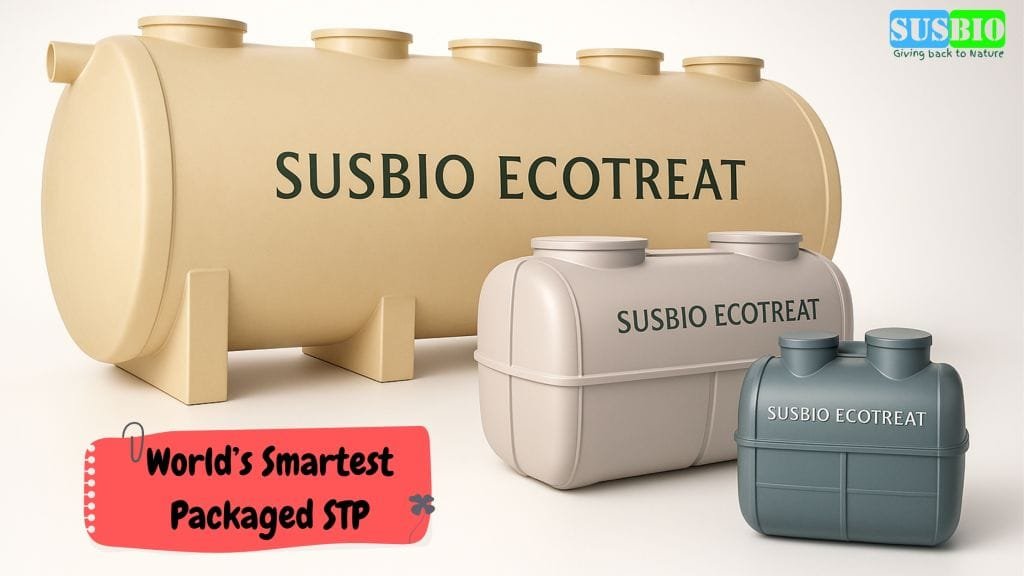
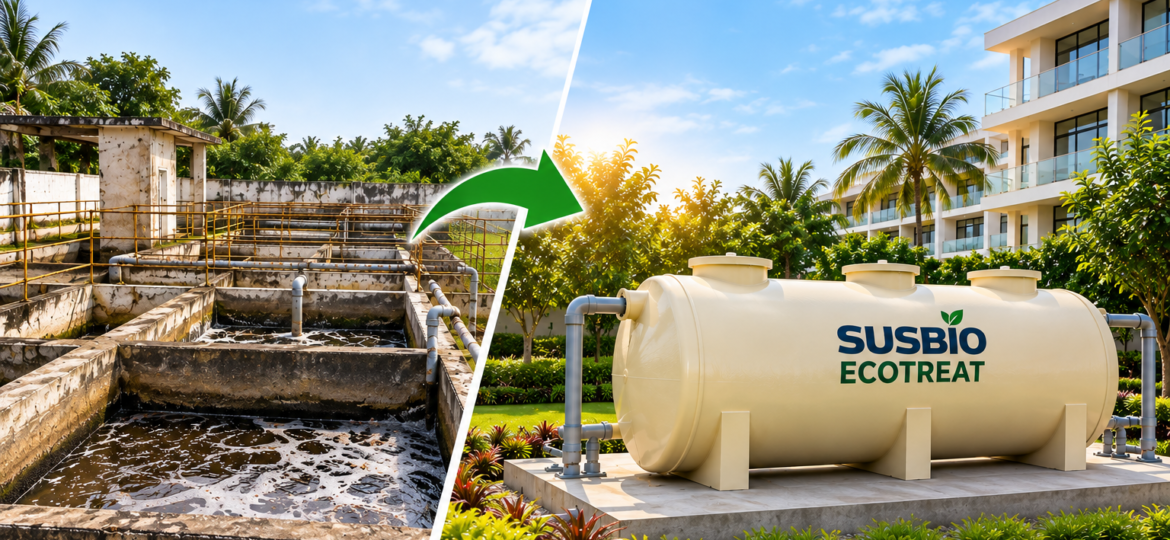
Every SUSBIO ETP project begins with an influent characterisation review. We ask for your water quality test report before proposing any system. The reactor technology is selected, the biological loading rate is set, and the sludge handling scope is defined from your actual effluent data — not a generic industrial template. We manufacture ETP vessels in FRP — the same corrosion-resistant, factory-fabricated material used in our ECOTREAT STP range. For applications where pH extremes, high TDS, or chemical content would corrode mild steel vessels within 3 to 5 years, FRP is the correct material choice.
SUSBIO prepares complete SPCB CTE and CTO documentation as standard scope — Design Basis Report, Process Flow Diagram, equipment specifications, and OCEMS integration documentation for applicable Red category industries. We have gone through the CTE/CTO process for industrial clients across Maharashtra, Karnataka, Goa, Tamil Nadu, Gujarat, and other states.
Industries we design ETPs for: pharmaceutical and API manufacturing with OCEMS integration and ZLD capability, food and beverage processing with DAF and FSSAI-aligned documentation, textile processing including colour removal and ZLD systems, chemical manufacturing with custom treatment trains from actual effluent characterisation, automotive and engineering facilities, and mixed industrial campuses requiring integrated ETP for process wastewater and STP for domestic sewage from the workforce.
ETP Plant Cost in India 2026 — Indicative Ranges
ETP costs vary significantly by industry type, influent strength, treatment train requirements, and capacity. These indicative ranges reflect properly engineered systems — including equalisation, sludge handling, and documentation — not stripped-down versions that omit critical stages:
| Application | Capacity | Indicative Supply + Install Cost |
|---|---|---|
| Small food / bakery unit | 10 – 25 KLD | Rs. 8 – 18 Lakhs |
| Dairy plant with DAF pre-treatment | 25 – 50 KLD | Rs. 18 – 35 Lakhs |
| Food processing, high BOD with anaerobic pre-treatment | 50 – 100 KLD | Rs. 30 – 60 Lakhs |
| Pharmaceutical ETP — conventional (no ZLD) | 25 – 100 KLD | Rs. 25 – 65 Lakhs |
| Pharmaceutical with ZLD — RO + MEE | 25 – 100 KLD | Rs. 80 Lakhs – 2 Crore+ |
| Textile dyeing ETP without ZLD | 100 – 500 KLD | Rs. 60 Lakhs – 2 Crore |
| Textile dyeing with full ZLD | 100 – 500 KLD | Rs. 2 Crore – 8 Crore+ |
| Electroplating / metal finishing | 5 – 50 KLD | Rs. 15 – 50 Lakhs |
| Automotive wash bay + surface treatment | 10 – 50 KLD | Rs. 10 – 30 Lakhs |
| Chemical manufacturing | 25 – 200 KLD | Project-specific — requires effluent characterisation |
Contact SUSBIO at susbio.in/contact-us/ for a free technical consultation and project-specific quotation. All SUSBIO ETP proposals include influent characterisation review, technology selection justification, and indicative SPCB documentation scope
Frequently Asked Questions
Q1. Is an ETP mandatory for my industry?
ETP is mandatory for all industries classified by CPCB as Red or Orange category under the Water (Prevention and Control of Pollution) Act 1974. Red category industries — pharmaceutical, textile dyeing, chemical, distillery, tannery, electroplating, sugar, pulp and paper — must install ETPs and obtain SPCB Consent to Establish before construction and Consent to Operate before production. Orange category industries including food processing and automotive have similar consent requirements. Operating without a required ETP exposes a facility to production shutdown orders, fines, and criminal proceedings under the Water Act.
Q2. What is OCEMS and does my industry need it?
OCEMS (Online Continuous Effluent Monitoring System) transmits real-time ETP outlet data — pH, BOD, COD, TSS, and flow — directly to CPCB and SPCB servers continuously. It is mandatory for 17 Red category industry categories including pharmaceutical manufacturing, textile dyeing, distilleries, sugar mills, and chemical manufacturing. With OCEMS, your ETP performance is under continuous regulatory scrutiny. SUSBIO designs and commissions OCEMS as integrated ETP scope for all applicable industries.
Q3. What is ZLD and which industries need it?
ZLD (Zero Liquid Discharge) means no treated liquid effluent is discharged outside the factory — all water is recovered and reused, with only solid residue for disposal. ZLD is mandatory for textile dyeing and printing units in most Indian states, pharmaceutical API manufacturing, distilleries, tanneries, and sugar mills in water-stressed and critically polluted areas. It requires conventional biological ETP followed by RO and MEE or spray drying for the RO reject concentrate. Compliance with general CPCB discharge limits is not an alternative to ZLD for mandated sectors — both requirements apply.
Q4. What is the difference between ETP and STP?
An ETP treats industrial process wastewater — chemicals, heavy metals, high-strength organic load from manufacturing processes. An STP treats domestic sewage — from toilets, bathrooms, and canteens — from the building’s occupants. An industrial facility typically needs both: ETP for process wastewater and STP for domestic sewage from its workforce. SUSBIO designs and supplies both, and for large industrial campuses can integrate both into a single system with shared tertiary and sludge handling stages.
Q5. How should industrial ETP sludge be disposed of?
Hazardous sludge from pharmaceutical, chemical, electroplating, and certain textile ETPs must be transported by SPCB-authorized carriers to authorized TSDF facilities, with full manifest documentation on file. Non-hazardous organic sludge from food processing ETPs may be composted or co-processed at cement kilns if it meets composition requirements. Improper sludge disposal is now a primary focus of SPCB surprise inspections and the most common basis for closure orders in 2025–2026.
Q6. How do I get SPCB CTE and CTO for my ETP?
CTE requires submission of Design Basis Report, Process Flow Diagram, site plan, equipment specifications, and effluent disposal plan before construction. CTO requires installation certificate, NABL-accredited lab performance test results over 3 to 7 consecutive days, and OCEMS certificate if applicable. CTE processing typically takes 45 to 120 days. SUSBIO prepares complete CTE and CTO documentation as standard scope for all ETP projects.
Q7. What is the ETP process — how does an ETP treat industrial wastewater?
An ETP treats industrial wastewater through sequential stages: preliminary treatment (screening, grit removal) removes large solids; equalisation buffers flow and load variability; primary treatment (DAF or clarifier) removes FOG and suspended solids; anaerobic pre-treatment breaks down high-strength organic load without aeration; aerobic biological treatment (MBBR or SBR) removes BOD and COD; secondary clarification separates sludge; tertiary treatment (sand filtration, activated carbon, UV) achieves final outlet quality. Each stage is essential — skipping or undersizing any stage creates downstream failure. The specific stages required depend entirely on your industry’s effluent characteristics.
Q8. How long does ETP installation and commissioning take in India?
ETP commissioning timeline from order to Consent to Operate (CTO): small packaged ETPs of 25 to 100 KLD take 8 to 16 weeks from order confirmation. Medium industrial ETPs of 100 to 500 KLD take 16 to 30 weeks. Large or ZLD systems take 30 to 52 weeks or more. After commissioning, add 4 to 12 weeks for SPCB CTO processing once performance test results are submitted. Total project timeline from order to CTO is typically 6 to 12 months for medium industrial ETPs. SUSBIO provides a detailed project schedule at the time of order confirmation.
Related Resources
• SUSBIO ETP — Product Page with System Specifications: https://susbio.in/effluent-treatment-plant-etp/
• ETP Plant for Food Industry — Design, FSSAI Compliance & Cost Guide: https://susbio.in/etp-plant-for-food-industry-essential-for-sustainable-operations/
• CPCB Effluent Discharge Standards 2026 — Complete Guide: https://susbio.in/breaking-down-india-environmental-regulations-cpcb/
• STP vs ETP — Which Treatment Plant Does Your Project Need: https://susbio.in/stp-vs-etp-which-treatment-plant-fits-your-industry-2025/
• Industrial STP Design Guide for Factories: https://susbio.in/step-by-step-guide-to-designing-a-sewage-treatment-plant-for-large-factories/
• Free ETP Design Consultation: https://susbio.in/contact-us/

2 Comments
[…] has built a reputation as the top ETP plant manufacturer in India by consistently delivering exceptional performance, reliability, and customer […]
[…] industrial wastewater and ensuring compliance with regulatory standards. Selecting the right ETP manufacturer can significantly impact your business operations, cost efficiency, and sustainability […]