

Every facility that generates wastewater in India — a residential apartment complex, a pharmaceutical manufacturing unit, a hotel, or a food processing plant — is legally required to treat that wastewater before discharge or reuse. The question that architects, project managers, EHS heads, and facility operators consistently face is: do we need a Sewage Treatment Plant, an Effluent Treatment Plant, or both?
Getting this wrong has direct consequences. A pharmaceutical plant that installs an STP instead of an ETP will not meet CPCB‘s industry-specific discharge limits for active pharmaceutical ingredients and heavy metals. A residential township that installs an ETP-grade chemical treatment system for domestic sewage has over-engineered and over-spent. And a large factory with both a worker canteen and a production floor often needs both systems running in parallel.
This guide provides a technically accurate, India-specific comparison of STP vs ETP — covering what each system treats, how each works, which industries and facilities need which system, what CPCB and SPCB regulations apply, and how to choose the right solution for your project. SUSBIO has designed and commissioned both STP and ETP systems across 500+ industrial and institutional projects in India since 2013.
STP vs ETP at a Glance
| Factor | STP (Sewage Treatment Plant) | ETP (Effluent Treatment Plant) |
|---|---|---|
| Treats | Domestic sewage — from toilets, bathrooms, kitchens | Industrial effluent — from manufacturing processes |
| Wastewater Source | Residential, commercial, institutional | Factories, pharmaceutical, textile, chemical units |
| Main Pollutants | Organic matter, pathogens, suspended solids, nutrients | Chemicals, heavy metals, dyes, solvents, toxic organics |
| Treatment Complexity | Moderate — primarily biological treatment | High — physical, chemical, and biological stages |
| CPCB BOD Outlet Standard | ≤ 30 mg/L (inland water); ≤ 10 mg/L (MPCB Mumbai) | ≤ 30 mg/L (general); industry-specific limits apply |
| Who Needs It | Apartments, hotels, hospitals, IT parks, offices | Pharma plants, textile mills, chemical units, food processing |
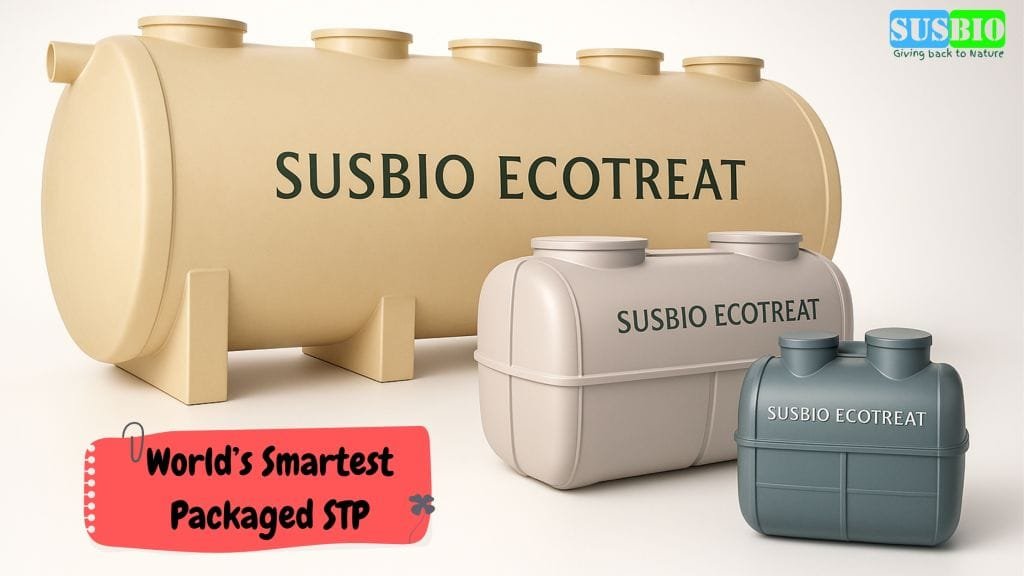
| SUSBIO Solution | SUSBIO ECOTREAT Packaged STP | SUSBIO ETP — engineered per industry |
What Is a Sewage Treatment Plant (STP)?
A Sewage Treatment Plant (STP) is a facility that treats domestic wastewater — the wastewater generated by human activities in residences, offices, hotels, hospitals, and other buildings. Domestic sewage primarily contains organic matter (food waste, human waste), suspended solids, nutrients (nitrogen and phosphorus), and pathogenic microorganisms. It does not, under normal circumstances, contain industrial chemicals, heavy metals, or toxic synthetic compounds.
The objective of an STP is to reduce the organic load (measured as BOD — Biochemical Oxygen Demand), remove suspended solids (TSS), eliminate pathogens through disinfection, and produce treated water that is safe for discharge to a water body or reuse for non-potable purposes such as flushing, gardening, or cooling tower makeup.
STP Treatment Stages
- Preliminary Treatment: Bar screens (coarse and fine) remove large solids, rags, and debris. Grit chambers remove sand and inorganic particles. Protects downstream equipment from damage.
- Equalisation Tank (EQ Tank): Buffers flow and load variations from morning and evening peak periods. Sized for 4-8 hours of average daily flow. Essential for consistent downstream biological treatment performance.
- Primary Treatment (optional): Primary clarifier settles 50-65% of TSS and removes 25-40% of BOD through gravity sedimentation. Often skipped in compact packaged STP systems using high-rate biological treatment.
- Secondary (Biological) Treatment: The core stage. Microorganisms break down dissolved and suspended organic matter. Technologies include MBBR (Moving Bed Biofilm Reactor), SBR (Sequential Batch Reactor), MBR (Membrane Bioreactor), and Activated Sludge Process. Achieves BOD removal of 85-95%.
- Secondary Clarifier: Separates treated effluent from biological sludge. Return Activated Sludge (RAS) is recycled; Waste Activated Sludge (WAS) goes to sludge handling.
- Tertiary Treatment: Sand filtration and activated carbon filtration remove residual suspended solids and colour. UV disinfection or chlorination eliminates pathogens. Produces water suitable for reuse.
- Sludge Handling: Biological sludge is thickened, dewatered (filter press or centrifuge), and disposed of through authorised channels or composting.
Who Needs an STP?
- Hotels, resorts, and service apartments
- Hospitals and healthcare facilities
- Educational institutions and campuses
- Industrial facilities — for domestic sewage from worker canteens, washrooms, and welfare facilities
- Restaurants and food courts generating kitchen wastewater
What Is an Effluent Treatment Plant (ETP)?
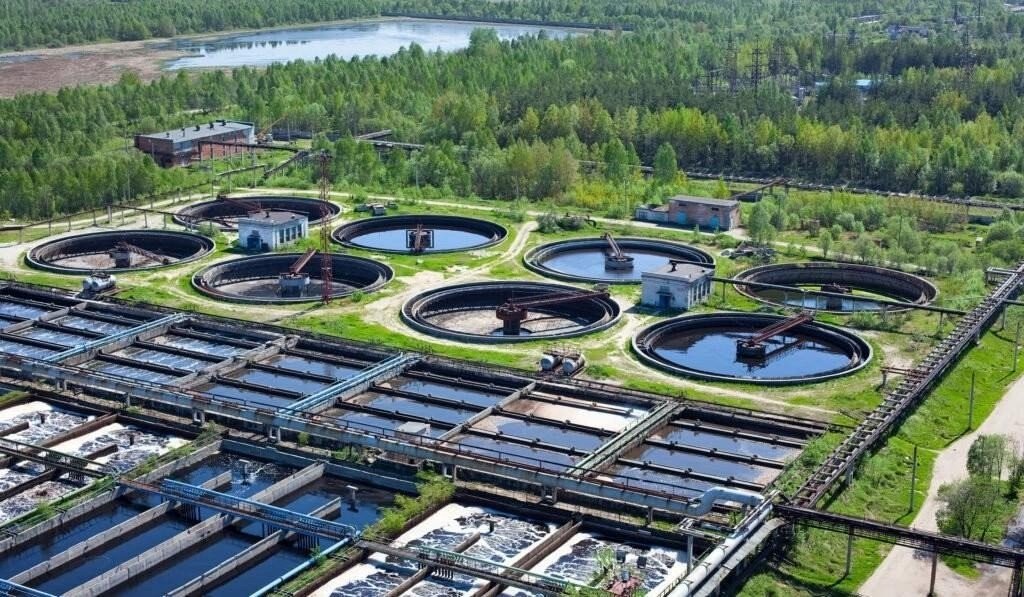
An Effluent Treatment Plant (ETP) is a facility that treats industrial process wastewater — the wastewater generated by manufacturing operations. Unlike domestic sewage, industrial effluent can contain a highly diverse and often hazardous range of pollutants depending on the industrial process: active pharmaceutical ingredients (APIs) and solvents from drug manufacturing, synthetic dyes and surfactants from textile processing, heavy metals (chromium, nickel, lead, cadmium) from metal finishing and electroplating, acids and alkalis from chemical production, oils and greases from automotive and engineering facilities, and high-BOD organic loads from food and beverage processing.
The composition of industrial effluent is unique to each industry and often to each specific facility. This is why ETP design is a specialised engineering discipline — a pharmaceutical ETP uses completely different treatment technology than a textile ETP, which in turn differs fundamentally from a tannery ETP. A one-size-fits-all ETP does not exist. Proper influent characterisation before design is non-negotiable.
ETP Treatment Stages
- Preliminary Treatment: Screening, oil and grease traps (DAF — Dissolved Air Flotation for oil-bearing effluent). Removes large solids and floating materials.
- Primary / Physico-Chemical Treatment: pH neutralisation (critical for acid/alkali effluent). Coagulation with alum or ferric chloride. Flocculation with polyelectrolyte. Primary clarifier or DAF for solid-liquid separation. Removes 60-80% of TSS and 30-50% of COD in this stage.
- Secondary (Biological) Treatment: Aerobic biological treatment (MBBR, ASP, SBR) for biodegradable organic matter removal. Anaerobic treatment (UASB, ABR) for high-COD effluents from food, dairy, distillery — often with biogas recovery. Nitrification/denitrification for nitrogen removal where required.
- Tertiary / Advanced Treatment: Sand filtration and activated carbon adsorption for residual COD and colour. Reverse Osmosis (RO) for TDS reduction and ZLD pre-treatment. Advanced Oxidation Processes (AOP — ozone, Fenton) for recalcitrant organic compounds that resist biological treatment. UV or ozonation for disinfection.
- Zero Liquid Discharge (ZLD): For industries facing ZLD mandates, RO concentrate is further processed through evaporators and crystallisers to produce dry salt. No liquid leaves the facility boundary.
- Sludge / Hazardous Waste Handling: Industrial sludge is often classified as hazardous waste under Hazardous Waste Management Rules. Requires filter press dewatering and disposal at authorised TSDF (Treatment, Storage, and Disposal Facility).
Who Needs an ETP?
- Pharmaceutical and bulk drug manufacturing units
- Textile dyeing, printing, and processing units
- Chemical and petrochemical plants
- Food and beverage processing facilities
- Leather and tannery units
- Automotive and metal finishing / electroplating facilities
- Sugar mills and distilleries
- Paper and pulp mills
- Power plants and refineries
STP vs ETP: Detailed Comparison
| Parameter | STP | ETP |
|---|---|---|
| Full Form | Sewage Treatment Plant | Effluent Treatment Plant |
| Wastewater Type | Domestic sewage | Industrial process effluent |
| Typical BOD of Influent | 150-300 mg/L | 500-50,000 mg/L depending on industry |
| Typical COD of Influent | 300-600 mg/L | 1,000-1,00,000 mg/L |
| Pollutants Treated | Organic matter, pathogens, nutrients | Chemicals, heavy metals, dyes, solvents, toxic organics |
| Treatment Complexity | Moderate | High to Very High |
| Chemical Dosing | Required Minimal (pH correction, disinfectant) | Significant (coagulants, flocculants, neutralisers) |
| Technology | MBBR, SBR, MBR, EA | Coagulation, DAF, MBBR, ASP, AOP, RO, ZLD |
| Capital Cost | Lower | Higher — depends heavily on effluent complexity |
| Operating Cost | Lower | Higher — chemicals, energy, sludge disposal |
| Sludge Classification | Non-hazardous (can be composted) | Often hazardous — requires TSDF disposal |
| CPCB Outlet BOD Standard | ≤ 30 mg/L (inland water) | ≤ 30 mg/L (general); industry-specific limits |
| ZLD Applicability | Rare — only for water-scarce mandated projects | Mandatory for textile, tannery, distillery, sugar in several states |
| OCEMS Requirement | For large municipal; optional for private | Mandatory for 17 Red Category industries |
| Design Standardisation | More standardised per capacity | Completely site-specific per industry and effluent |
CPCB and SPCB Regulations: STP vs ETP Compliance in India
Both STPs and ETPs in India are governed by a layered regulatory framework. Understanding which regulations apply to your facility is essential before selecting the treatment system.
For STP (Domestic Sewage Treatment)
- Environment (Protection) Act, 1986 and Rules, 1986 — Schedule VI sets general discharge standards (BOD ≤ 30 mg/L for inland surface water).
- CPCB General Standards — minimum national standards for sewage treatment.
- State-specific standards — MPCB (Maharashtra/Mumbai) mandates BOD ≤ 10 mg/L, significantly stricter than national standard. Always verify your SPCB’s applicable standard.
- Consent to Establish (CTE) and Consent to Operate (CTO) from SPCB required before installation and after commissioning.
- Water reuse mandate — many states, including Maharashtra and Karnataka, require 50-100% of treated sewage to be recycled for non-potable use.
- NGT orders — multiple NGT directives require functional STPs in residential, commercial, and institutional buildings above specified built-up area thresholds.
For ETP (Industrial Effluent Treatment)
- Environment (Protection) Act, 1986 — primary legislation. Schedule VI sets minimum discharge standards; industry-specific standards apply additionally.
- Industry-specific CPCB standards — pharmaceutical (API limits, heavy metals), textile (colour norms, AOX), tannery (chromium ≤ 2 mg/L), automotive (Cr(VI) ≤ 0.1 mg/L, CN ≤ 0.2 mg/L).
- OCEMS (Online Continuous Effluent Monitoring System) — mandatory for 17 Red category industries; real-time BOD, COD, TSS, pH, flow data transmitted to CPCB servers.
- ZLD mandates — currently mandatory for textile dyeing, tanneries, sugar mills, distilleries, and pulp/paper mills in several Indian states by CPCB/NGT orders.
- Hazardous Waste Management Rules — industrial sludge from ETPs in certain categories classified as hazardous waste; TSDF disposal mandatory.
- CTE and CTO from SPCB — including performance test compliance (3-7 days of consecutive compliant outlet samples) for CTO.
Key regulatory point: Industries in ‘Red Category’ (pharmaceutical, textile, chemical, tannery, etc.) must install both an STP (for domestic sewage from worker facilities) AND an ETP (for process effluent) — and maintain OCEMS on the ETP outlet. SUSBIO designs combined STP+ETP systems for facilities requiring both.
Which Treatment Plant Do You Need? A Clear Decision Framework
Use this framework to determine whether your facility needs an STP, an ETP, or both.
| Your Facility Type | You Need | SUSBIO Solution |
|---|---|---|
| Residential apartment / housing society | STP only | SUSBIO ECOTREAT Packaged STP |
| Hotel / resort / serviced apartment | STP only | SUSBIO ECOTREAT Packaged STP |
| Hospital / clinic | STP (with enhanced disinfection) | SUSBIO ECOTREAT with UV stage |
| IT park / office complex | STP only | SUSBIO ECOTREAT Packaged STP |
| Restaurant / food court | STP with grease trap pre-treatment | SUSBIO ECOTREAT with DAF pre-treatment |
| Pharmaceutical plant | ETP (for process effluent) + STP (for domestic sewage) | SUSBIO ETP + SUSBIO ECOTREAT |
| Textile / dyeing unit | ETP (for process effluent) + STP (for domestic sewage) | SUSBIO ETP with colour removal + SUSBIO ECOTREAT |
| Food processing factory | ETP (for high-BOD process effluent) + STP | SUSBIO ETP with anaerobic pre-treatment + SUSBIO ECOTREAT |
| Chemical / petrochemical plant | ETP (for process effluent) + STP | SUSBIO ETP engineered per effluent + SUSBIO ECOTREAT |
| Automotive / metal finishing | ETP (for process + oily effluent) + STP | SUSBIO ETP with DAF + heavy metal treatment + SUSBIO ECOTREAT |
| Large factory with canteen only (no process effluent) | STP only | SUSBIO ECOTREAT Industrial Packaged STP |
| Industrial township / SEZ | Combined STP for domestic + ETP for industrial tenants | SUSBIO combined system design |
SUSBIO: India's Leading Manufacturer of Both STP and ETP Systems
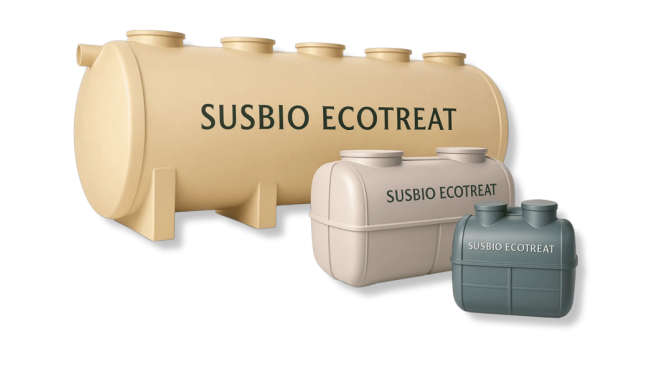
SUSBIO (Sustainable Biosolutions Pvt. Ltd.) has been engineering, manufacturing, and commissioning sewage treatment plants and effluent treatment plants across India since 2013. With manufacturing at Vasuli MIDC, Chakan, Pune and headquarters in Goa, SUSBIO serves industrial, commercial, and institutional clients in 24 Indian states.
The critical distinction in SUSBIO’s approach: every project begins with actual influent sampling and characterisation — measuring BOD, COD, TSS, pH, heavy metals, and specific pollutants before designing the system. This ensures every SUSBIO STP and ETP is designed for the actual wastewater, not assumed values. It is why SUSBIO installations consistently pass SPCB inspections year after year.
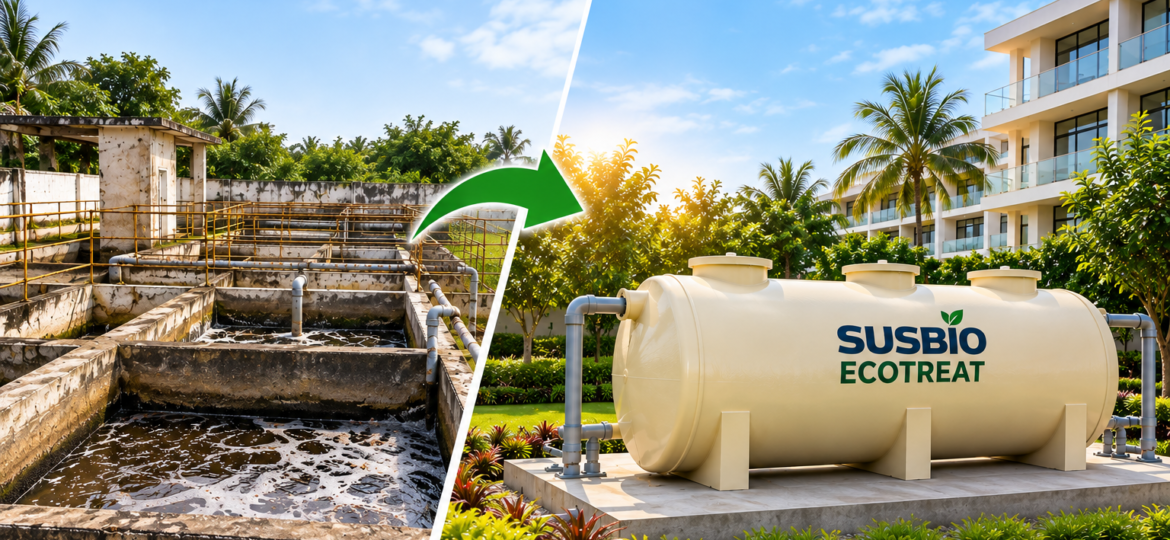
SUSBIO ECOTREAT — For STP Applications
- FRP (Fibre Reinforced Plastic) prefabricated construction — corrosion-resistant, 45–50 year design life.
- Anaerobic + MBBR hybrid technology — anaerobic pre-treatment ahead of a Moving Bed Biofilm Reactor — achieves BOD below 10 mg/L, meeting even MPCB’s strictest standard
- Compact footprint — up to 60% smaller than equivalent civil STP
- Factory pre-tested before dispatch from Pune manufacturing facility
- Capacity range: 5 KLD to 500+ KLD in modular configurations
- OCEMS-ready — pre-wired for online monitoring compliance
- Full SPCB CTE and CTO documentation support
SUSBIO ETP — For Industrial Effluent Treatment Applications
- Site-specific influent characterisation before every ETP design — no generic product supply
- Multi-industry expertise: pharmaceutical, textile, food, chemical, automotive, leather
- Technology range: Coagulation-Flocculation, DAF, MBBR, ASP, SBR, Anaerobic, MBR, RO, AOP, ZLD
- Complete sludge management design — including hazardous waste handling and TSDF coordination
- OCEMS integration for Red Category industries with full CPCB server connectivity
- ZLD system design for industries facing mandatory Zero Liquid Discharge requirements
- Lifetime service commitment from SUSBIO’s engineering teams
Akshat Tyagi, Founder SUSBIO: ‘The most expensive mistake I see in Indian industry is installing the wrong type of treatment plant — a facility installs a standard STP for what is actually complex industrial effluent, achieves BOD 25 mg/L when the SPCB limit is 10 mg/L, and then faces a non-compliance notice. Always characterise the effluent first. Design for the actual wastewater, not the assumed one.’
Frequently Asked Questions: STP vs ETP
Q1. What is the main difference between STP and ETP?
The primary difference is the type of wastewater each system treats. An STP (Sewage Treatment Plant) treats domestic sewage from toilets, bathrooms, and kitchens — wastewater containing organic matter and pathogens. An ETP (Effluent Treatment Plant) treats industrial process effluent containing chemicals, heavy metals, dyes, solvents, and other industrial pollutants. STPs use primarily biological treatment. ETPs combine physical, chemical, and biological treatment stages, and are significantly more complex because industrial effluent characteristics vary widely between industries.
Q2. Can an STP treat industrial effluent?
No, not reliably. A standard STP is designed for domestic sewage with BOD of 150-300 mg/L and no chemical toxicity. Industrial effluent can have BOD of 1,000-50,000 mg/L and may contain compounds that are toxic to biological treatment microorganisms — completely disrupting STP performance. Industrial effluent requires an ETP specifically designed for the effluent characteristics of that industry. Attempting to treat industrial effluent in a domestic STP typically results in system failure and SPCB non-compliance.
Q3. Does a factory need both an STP and an ETP?
In most cases, yes. A factory generates two distinct types of wastewater: domestic sewage from worker toilets, canteens, and washrooms (which needs an STP), and process effluent from manufacturing operations (which needs an ETP). These two streams have completely different characteristics and must be treated separately. SUSBIO designs combined STP + ETP systems for factories, with each system sized and engineered for its specific wastewater stream.
Q4. What are the CPCB outlet standards for STP and ETP discharge?
For STP discharge to inland surface water, CPCB mandates BOD ≤ 30 mg/L, COD ≤ 250 mg/L, TSS ≤ 100 mg/L, pH 6.5-8.5, and fecal coliform ≤ 1,000 MPN/100 mL. Note that state PCBs may enforce stricter limits — MPCB (Maharashtra) requires BOD ≤ 10 mg/L. For ETP discharge, CPCB sets general standards plus industry-specific standards covering heavy metals, specific toxic compounds, colour, and other parameters relevant to each industry type. Always verify the applicable SPCB standard for your specific state and industry category.
Q5. What is ZLD and which industries need it?
ZLD (Zero Liquid Discharge) means no liquid effluent leaves the facility boundary — all water is treated and recycled on-premises. ZLD is currently mandatory for textile dyeing and finishing units, tanneries, sugar mills, distilleries, and pulp/paper mills in several Indian states under CPCB/NGT orders. ZLD systems require advanced tertiary treatment including Reverse Osmosis (RO) and evaporator-crystalliser technology to convert RO concentrate into dry salt. SUSBIO designs complete ZLD systems for industries facing this mandate.
Q6. What is OCEMS and which facilities need it?
OCEMS (Online Continuous Effluent Monitoring System) is a real-time monitoring system that measures BOD, COD, pH, TSS, and flow in industrial effluent and transmits data directly to CPCB servers. OCEMS is mandatory for 17 categories of highly polluting Red Category industries in India — including pharmaceutical, textile, chemical, tannery, sugar, paper, and others. It is required on ETP outlets for these industries. Non-functional OCEMS is treated as a compliance failure. SUSBIO provides complete OCEMS design, installation, and CPCB server connectivity as part of every applicable ETP project.
Q7. How do I choose between MBBR and SBR technology for my STP?
MBBR (Moving Bed Biofilm Reactor) is better suited for continuous flow applications, variable organic loads, and constrained footprints. It is SUSBIO’s preferred biological treatment technology for residential and commercial STPs because it tolerates load variations common in these applications without process disruption. SBR (Sequential Batch Reactor) is better suited for variable flow applications — particularly industrial facilities with shift-based production and batch discharge patterns. Both technologies reliably achieve BOD below 10 mg/L when correctly designed. SUSBIO’s engineering team recommends the appropriate technology after reviewing your specific flow pattern and influent characteristics.
Q8. What is the cost of an STP vs ETP in India?
STP cost depends on capacity and technology. Packaged SUSBIO ECOTREAT STP systems range from approximately Rs. 3 lakhs (5 KLD) to Rs. 1.5+ crore (500 KLD). ETP cost is significantly more variable because it depends on effluent complexity — a simple food processing ETP for 50 KLD may cost Rs. 20-40 lakhs, while a pharmaceutical ZLD system for the same capacity could cost Rs. 1-3 crore. SUSBIO provides free influent assessment and indicative budgetary proposals for both STP and ETP projects. Contact SUSBIO for a project-specific proposal.
Conclusion: Choosing Between STP and ETP — Get It Right the First Time
The difference between a Sewage Treatment Plant and an Effluent Treatment Plant is not just technical — it is regulatory, financial, and operational. Installing the wrong system means non-compliance with CPCB and SPCB standards, costly retrofits, SPCB show cause notices, and in the worst cases, forced shutdown of operations.
The decision framework is straightforward once you understand your wastewater. If your facility generates domestic sewage from toilets, canteens, and washrooms — you need an STP. If your facility generates industrial process effluent containing chemicals, heavy metals, dyes, or solvents — you need an ETP. If your facility generates both — which most factories and large industrial campuses do — you need both systems running in parallel, each designed for its specific wastewater stream.
What makes the difference between a compliant, long-running treatment system and a chronically non-compliant one is not the technology — it is the quality of the design. Every SUSBIO STP and ETP project begins with actual influent characterisation. We measure before we design. That is why SUSBIO installations consistently pass SPCB inspections year after year across 24 Indian states.
Whether you are a factory owner in Pune evaluating your first ETP, a residential developer in Mumbai navigating MPCB’s 10 mg/L BOD standard, a hospital administrator in Hyderabad planning a new STP, or an EHS manager in a pharmaceutical plant facing an OCEMS compliance deadline — SUSBIO’s engineering team is equipped to deliver the right solution with complete regulatory documentation support and lifetime service commitment.
Contact SUSBIO today for a free technical consultation, influent assessment, and budgetary proposal.
www.susbio.in/contact-us | info@susbio.in | +91 88889 80197
Explore More from SUSBIO
• SUSBIO ECOTREAT Full Range: https://susbio.in/susbio-ecotreat/
• SUSBIO ETP Solutions: https://susbio.in/effluent-treatment-plant-etp/
• ETP Role and Importance Guide: https://susbio.in/effluent-treatment-plants-etp-role-importance-and-why-they-matter/
• STP Capacity Calculator: https://susbio.in/how-to-calculate-sewage-treatment-plant-capacity/
• CPCB Guidelines 2026: https://susbio.in/government-standards-and-guidelines-for-sewage-treatment-plants-stps-in-india-2026-expert-guide/
• Free Consultation: https://susbio.in/contact-us/