


India generates approximately 72,368 million litres of sewage every single day. Yet according to the Central Pollution Control Board (CPCB), the country’s treatment capacity covers barely 44% of that volume — and actual treatment rates are even lower. The consequences show up in our rivers, groundwater, and in the waterborne disease burden borne by millions of people.
A Sewage Treatment Plant (STP) is the answer to this challenge. Whether you are a municipal engineer planning new infrastructure, a housing society operator managing an existing facility, or a developer required to install an on-site STP under local regulations — understanding how an STP works is the starting point for every good decision.
This guide explains the complete sewage treatment process — from the moment raw wastewater enters the plant to the moment clean, compliant effluent leaves it — along with the main STP technologies used in India, CPCB discharge norms, and how to choose the right system for your application.
What Is a Sewage Treatment Plant?
A Sewage Treatment Plant (STP) — also referred to as a wastewater treatment plant or, in industrial contexts, an effluent treatment plant — is a facility designed to remove contaminants from sewage before that water is safely returned to the environment or reused.
Raw sewage is a complex mixture of:
- Organic matter — food waste, human excreta, and biological material
- Suspended solids — sand, grit, plastic fragments, and paper
- Pathogens — bacteria, viruses, and parasites responsible for waterborne diseases
- Nutrients — nitrogen and phosphorous compounds from detergents and household waste
- Chemicals — from commercial and light industrial activity mixed into municipal sewers
Left untreated, this mix depletes oxygen in rivers and lakes (killing aquatic life), contaminates drinking water sources, and creates breeding grounds for disease. The STP’s job is to systematically remove or neutralise each of these contaminants through a sequence of physical, biological, and chemical processes.
Why STPs Are a National Priority in India
India’s urban sewage generation has grown faster than its treatment infrastructure. The gap between generation and treatment capacity is one of the country’s most urgent environmental challenges.
Some numbers that frame the scale of the problem:
- India’s urban areas generate ~72,368 MLD of sewage daily (CPCB, 2021)
- Installed treatment capacity stands at only ~31,841 MLD — covering roughly 44% of generation
- The Namami Gange Programme has sanctioned over 157 STP projects along the Ganga basin alone, adding 4,952 MLD of new capacity
- AMRUT 2.0 and the Jal Jeevan Mission are driving large-scale investment in urban sewage infrastructure across all Tier-1 and Tier-2 cities
This infrastructure push means thousands of new STPs will be designed, built, and operated across India over the next decade — creating demand for engineering expertise, technology, and operators who understand the full treatment process.
How a Sewage Treatment Plant Works: The 4-Stage Process
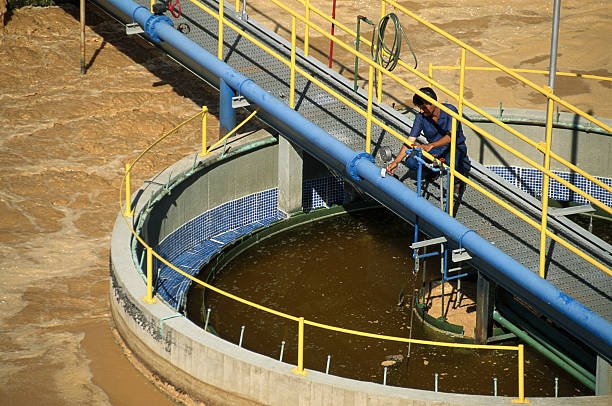
A modern STP treats wastewater through four sequential stages. Each stage targets a different class of contaminants, progressively cleaning the water until it meets the required discharge or reuse standard.
Stage 1: Preliminary Treatment — Screening and Grit Removal
Raw sewage enters the plant through the inlet works, and the first task is to remove large solids and abrasive material that would damage equipment downstream.
- Coarse Screening: Bar screens (gaps of 20–75 mm) capture large debris — rags, plastic bags, sticks, and other material that would clog pumps and pipes.
- Fine Screening: Secondary screens with gaps of 1–10 mm remove smaller particles.
- Grit Removal: Grit chambers use controlled flow velocity to allow heavy particles — sand, gravel, eggshells — to settle by gravity, while lighter organic material stays in suspension and passes forward for biological treatment.
- Flow Equalisation (in larger plants): Buffer tanks absorb peak-hour flow surges, delivering a consistent load to downstream processes.
Output: Screened, grit-free wastewater — ready for primary settling.
Stage 2: Primary Treatment — Sedimentation
Primary treatment is a purely physical process. The screened wastewater flows at low velocity into large Primary Clarifiers (sedimentation tanks), where gravity does the work.
- Heavier suspended solids sink to the bottom of the tank over a retention period of 1.5–2.5 hours, forming raw primary sludge.
- Fats, oils, and grease (FOG) float to the surface and are mechanically skimmed off.
- The clarified liquid (primary effluent) overflows from the top and advances to secondary treatment.
This stage removes approximately 50–70% of suspended solids and 25–40% of Biochemical Oxygen Demand (BOD) from the incoming sewage. The primary sludge collected at the bottom is pumped to sludge handling systems for further treatment.
Stage 3: Secondary Treatment — Biological Processing
Secondary treatment is the biological core of every STP. Here, microorganisms — bacteria and other microbes — break down the dissolved and colloidal organic matter that survived primary treatment. A well-operated secondary stage removes 85–95% of BOD.
Several technologies achieve this, each suited to different applications:
Activated Sludge Process (ASP): The traditional method, widely used in large municipal STPs. Primary effluent is mixed with active microbial biomass (activated sludge) in an aeration tank, then passes to a secondary clarifier where the biomass settles and is returned to the aeration tank. Effective but land-intensive.
Sequencing Batch Reactor (SBR): An advanced variation where fill, react, settle, and decant all happen in a single tank in timed sequence — eliminating the need for a separate clarifier. SBR is highly flexible and excels at meeting nutrient removal requirements.
Moving Bed Biofilm Reactor (MBBR): Plastic carrier media suspended in the aeration tank provide a high-surface-area substrate for biofilm growth, achieving very high biomass concentrations in a compact footprint. Popular for housing societies, commercial complexes, and capacity upgrades.
Membrane Bioreactor (MBR): Combines biological treatment with ultrafiltration or microfiltration membranes (pores as small as 0.04 microns), physically removing bacteria, suspended solids, and some viruses in a single step. Produces near-potable quality effluent — ideal for water reuse applications.
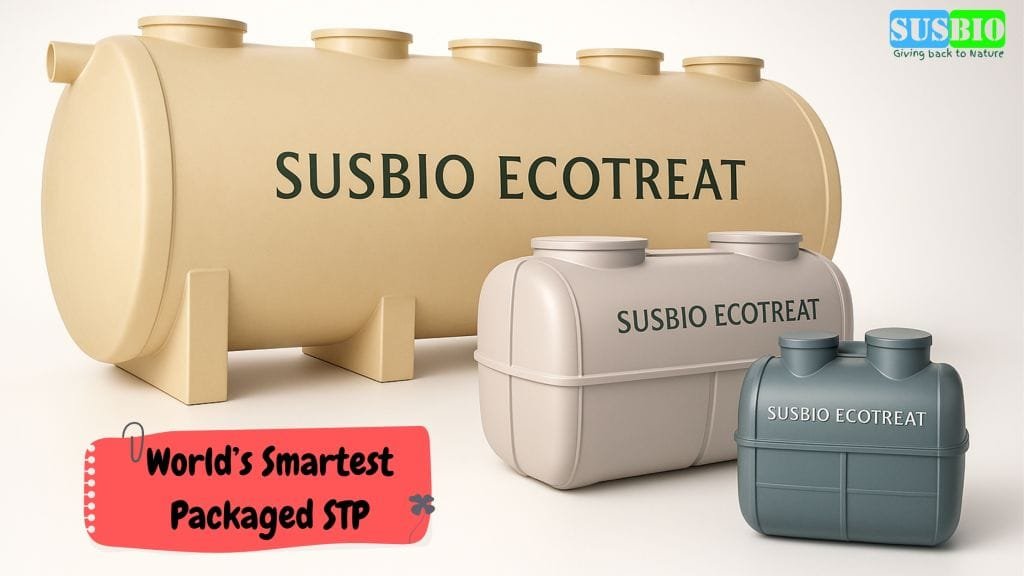
SUSBIO ECOTREAT (MBBR + MBR Hybrid): SUSBIO’s proprietary technology integrates MBBR robustness with MBR effluent quality in one compact, optimised system. ECOTREAT consistently meets CPCB Class A norms, making treated water suitable for toilet flushing, landscaping, and industrial cooling — directly reducing freshwater consumption at the source.
Output: Biologically treated effluent with BOD typically below 30 mg/L (standard CPCB norm), ready for tertiary polishing or — in some low-sensitivity cases — direct discharge.
Stage 4: Tertiary Treatment — Advanced Polishing
Tertiary treatment upgrades the biologically treated effluent to the quality required for its final use — whether that is discharge into a river, irrigation of crops, or reuse within a building.
- Filtration (sand, dual media, multimedia): Reduces residual TSS to below 5 mg/L
- UV Disinfection or Chlorination: Eliminates residual pathogens — bacteria, viruses — to meet fecal coliform standards. UV is preferred for reuse applications as it leaves no chemical residuals.
- Activated Carbon Adsorption: Removes colour, odour, trace organics, and micropollutants
- Nutrient Removal: Biological nitrification/denitrification removes nitrogen; chemical precipitation or biological EBPR removes phosphorous — critical for discharge near sensitive water bodies
- Reverse Osmosis (RO): For the highest-purity applications, RO removes dissolved salts, micropollutants, and trace metals
Output: Treated water meeting CPCB Class A (reuse) or Class B/C (discharge) standards, depending on the combination of tertiary processes applied.
What Happens to the Sludge?
Every STP produces sludge — the semi-solid byproduct of primary settling and secondary biological treatment. Sludge management is an integral part of the treatment process and must comply with CPCB solid waste regulations.
| Sludge Treatment Step | What Happens | Output |
|---|---|---|
| Thickening | Gravity or mechanical thickening reduces volume | 4–8% solids content |
| Anaerobic Digestion | Microbes break down organic matter in absence of oxygen, producing biogas (methane) | Digested sludge + biogas |
| Dewatering | Belt press, centrifuge, or filter press removes water mechanically | Filter cake at 20–30% solids |
| Final Reuse / Disposal | Pathogen-free biosolids used as agricultural amendment; contaminated sludge goes to landfill or incineration | Compost / biosolids / ash |
In well-designed plants, biogas from anaerobic digestion powers a Combined Heat and Power (CHP) unit — partially or fully offsetting the STP’s electricity consumption and significantly reducing operational costs.
Types of Sewage Treatment Plants: At a Glance
| Technology | Capacity | Footprint | Effluent Quality | Best For |
|---|---|---|---|---|
| Activated Sludge (ASP) | 1 MLD–500+ MLD | Large | BOD <30 mg/L | Large municipal STPs |
| Sequencing Batch Reactor (SBR) | 100 KLD–100 MLD | Medium | BOD <10 mg/L | Municipal, townships |
| MBBR | 50 KLD–50 MLD | Compact | BOD <20 mg/L | Housing, commercial |
| Membrane Bioreactor (MBR) | 50 KLD–20 MLD | Very compact | BOD <5 mg/L | Reuse, hospitals, hotels |
| SUSBIO ECOTREAT (MBBR+MBR) | 50 KLD–10 MLD | Most compact | BOD <5 mg/L | Residential, industrial, reuse |
| Packaged STP | 10 KLD–500 KLD | Minimal | BOD <30 mg/L | Sites, small communities |
CPCB Discharge Standards for STPs in India
All sewage treatment plants operating in India must meet effluent discharge standards set by the Central Pollution Control Board (CPCB) under the Environment Protection Act, 1986. State Pollution Control Boards (SPCBs) may impose stricter limits for ecologically sensitive locations.
| Parameter | Class A (Reuse) | Class B (Irrigation) | Class C (River Discharge) |
|---|---|---|---|
| BOD (mg/L) | ≤ 10 | ≤ 20 | ≤ 30 |
| COD (mg/L) | ≤ 50 | ≤ 75 | ≤ 250 |
| TSS (mg/L) | ≤ 10 | ≤ 30 | ≤ 30 |
| pH | 6.0–9.0 | 6.0–9.0 | 5.5–9.0 |
| Fecal Coliform (MPN/100 mL) | ≤ 100 | ≤ 1,000 | ≤ 1,000 |
| Total Nitrogen (mg/L) | ≤ 10 | — | — |
| Total Phosphorous (mg/L) | ≤ 1 | — | — |
Important: Plants located in Ganga basin towns — covering cities and towns across Uttarakhand, Uttar Pradesh, Bihar, Jharkhand, and West Bengal — must now meet Class A standards as a mandatory condition of the Namami Gange Programme.
The Role and Importance of Sewage Treatment Plants
Environmental Protection: Untreated sewage is the single largest source of water body pollution in India. STPs prevent the degradation of rivers, lakes, and groundwater by removing BOD, TSS, nutrients, and pathogens before discharge.
Public Health: Waterborne diseases — cholera, typhoid, dysentery, hepatitis A — are largely caused by fecal contamination of water sources. Properly operated STPs break this chain of transmission by eliminating pathogens to safe levels.
Water Reuse and Security: India faces acute freshwater stress. Treated sewage, processed to Class A standards, can be safely reused for toilet flushing, landscape irrigation, industrial cooling, and groundwater recharge — directly reducing demand on freshwater resources. Cities and industrial parks are increasingly mandating treated water reuse as part of Zero Liquid Discharge (ZLD) strategies.
Legal Compliance: The National Green Tribunal (NGT) has imposed substantial financial penalties on municipalities and industries for discharging untreated sewage. Operating an STP that meets CPCB norms is a legal obligation — not an option.
Frequently Asked Questions About Sewage Treatment Plants
Q: What is the difference between an STP and an ETP?
An STP (Sewage Treatment Plant) treats domestic and municipal wastewater — from homes, offices, and commercial buildings. An ETP (Effluent Treatment Plant) treats industrial process wastewater, which may contain heavy metals, toxic chemicals, or high-strength organic loads not found in domestic sewage. While both use similar unit operations, ETPs typically require additional chemical treatment steps specific to the industry they serve.
Q: What STP capacity is required for a housing society in India?
Most SPCBs require housing societies with more than 100 flats (or 50+ dwelling units in Tier-1 cities) to install on-site STPs. Capacity is calculated at 135 litres per capita per day (LPCD) — so a 500-flat society with approximately 2,000 residents would need a minimum STP capacity of 270 KLD. SUSBIO’s packaged ECOTREAT systems start at 50 KLD and can be modularly expanded.
Q: How long does sewage treatment take?
Total hydraulic retention time (HRT) in a typical STP is 8–24 hours. Preliminary and primary stages take 1–3 hours; secondary biological treatment (aeration) requires 6–12 hours; tertiary polishing adds 1–2 hours. Advanced MBR systems achieve equivalent or better treatment quality in shorter HRTs due to the physical barrier of membranes.
Q: Can treated sewage be reused for flushing and irrigation?
Yes. Sewage treated to CPCB Class A standards — BOD ≤ 10 mg/L, TSS ≤ 10 mg/L, fecal coliform ≤ 100 MPN/100 mL — is approved for non-potable reuse including toilet flushing, cooling towers, dust suppression, and irrigation of non-edible crops. SUSBIO’s ECOTREAT systems are specifically designed to consistently achieve Class A output, making on-site water recycling a practical and regulatory-compliant reality.
Q: What are the CPCB norms for STP effluent?
CPCB classifies treated effluent into Classes A through D based on intended end use. Class A (reuse) requires BOD ≤ 10 mg/L, COD ≤ 50 mg/L, TSS ≤ 10 mg/L, and fecal coliform ≤ 100 MPN/100 mL. Class C (river discharge) allows BOD ≤ 30 mg/L, COD ≤ 250 mg/L, TSS ≤ 30 mg/L. Plants in Ganga basin towns must meet Class A norms regardless of intended end use.
Conclusion
A sewage treatment plant is far more than an infrastructure asset — it is a guardian of public health, ecological balance, and water security. Understanding how an STP works, from preliminary screening to tertiary polishing, is the foundation for making sound decisions about sewage management — whether you are planning a new system, upgrading an existing one, or ensuring regulatory compliance.
For India, with rapid urbanisation continuing and government programmes channelling unprecedented investment into sewage infrastructure, the importance of choosing the right STP technology has never been greater. The convergence of regulatory pressure (CPCB, NGT, Namami Gange) and technological advancement (MBR, MBBR, hybrid systems) is creating an opportunity to close India’s treatment gap decisively.
SUSBIO’s ECOTREAT technology represents this next generation of sewage treatment — compact, efficient, reuse-ready, and compliant with the most stringent CPCB norms. From a 50 KLD packaged plant for a residential complex to multi-MLD modular systems for townships and industrial estates, SUSBIO engineers site-specific solutions that perform.
Need an STP for Your Project?
SUSBIO designs and supplies compact, CPCB-compliant Sewage Treatment Plants — from 50 KLD packaged units to large township systems — across globe.
Get a Free Consultation | Contact SUSBIO Today



35 Comments
[…] 0 By Akshat Tyagi Latest Blogs July 9, […]
[…] while meeting stringent environmental regulations. This blog delves into why hotels need sewage treatment plants (STPs), the challenges they address, and how SUSBIO ECOTREAT offers a state-of-the-art solution for […]
[…] Sewage treatment plants play a crucial role in safeguarding the environment and conserving water resources. By effectively treating wastewater, these plants remove harmful pollutants and pathogens, ensuring that the water released back into the environment is clean and safe. This not only protects aquatic ecosystems but also prevents waterborne diseases and safeguards public health. Moreover, sewage treatment plants help in the sustainable management of water resources by recycling treated wastewater for various purposes such as irrigation, industrial processes, and even potable water in some cases. Overall, these plants contribute significantly to mitigating water pollution, conserving water, and promoting environmental sustainability. […]
[…] Untreated sewage leads to environmental pollution and poses a significant health risk. Sewage Treatment Plants (STPs) play a vital role […]
[…] increase comes the need for efficient and sustainable solutions for wastewater management. Sewage Treatment Plants (STPs) are crucial in ensuring that wastewater generated by apartment complexes is […]
[…] Sewage Wastewater Treatment, its types, reasons for sewage generation, the role of Sewage Treatment Plants (STPs), and innovative solutions like packaged STPs that are transforming wastewater […]
[…] industrial areas, or large-scale commercial properties, managing sewage effectively is essential. Sewage Treatment Plants (STPs) are at the heart of this transformation, ensuring that wastewater is treated and can be […]
[…] daily, including organic waste, chemicals, and other pollutants. Without a well-designed sewage treatment plants (STPs), untreated sewage can lead to environmental hazards, health issues, and even financial penalties […]
[…] offers a range of sewage treatment plants designed for domestic use. These systems primarily rely on traditional treatment technologies like […]
[…] Sewage treatment plants often face issues related to outdated or insufficient infrastructure. Many plants operate with older equipment that struggles to meet the demands of modern wastewater volumes and regulatory standards. […]
[…] 2025, the demand for efficient, eco-friendly, and innovative sewage treatment plants (STPs) has reached an all-time high. With growing awareness about environmental sustainability, […]
[…] the demand for sustainable and efficient wastewater management grows, sewage treatment plants (STPs) have become essential for residential, commercial, and industrial properties. They ensure […]
[…] Two essential technologies for treating wastewater are Effluent Treatment Plants (ETPs) and Sewage Treatment Plants (STPs). While both systems aim to treat wastewater before its discharge or reuse, their processes, […]
[…] waste management in healthcare facilities. In this blog, we will explore why hospitals need sewage treatment plants, the ideal features of an STP for hospitals, and why SUSBIO ECOTREAT stands out as the best […]
[…] witnessing rapid urbanization and industrial growth, leading to an increased demand for efficient sewage treatment plants (STPs). While STPs play a crucial role in wastewater management, their operation comes with […]
[…] treatment is essential for maintaining environmental sustainability and public health. Modern sewage treatment plants (STPs) are designed with advanced technologies to efficiently purify water before it is discharged […]
[…] sustainability and public health. Two common treatment systems used for wastewater management are Sewage Treatment Plants (STP) and Effluent Treatment Plants (ETP). While both serve the purpose of treating wastewater, […]
[…] of Proper Sewage Treatment: Many urban and rural areas lack adequate sewage treatment plants (STPs), leading to direct discharge into water […]
[…] is a multi-step process that transforms wastewater into environmentally safe water. The primary sewage treatment plant process steps […]
[…] urbanization accelerates and environmental concerns grow, the need for efficient sewage treatment plants (STPs) has never been more pressing. Traditional wastewater treatment systems often struggle […]
[…] struggles to keep up, leading to environmental concerns and water pollution. This is why efficient sewage treatment plants (STPs) are essential for Hyderabad’s sustainable […]
[…] sewage treatment company specializing in the design, manufacturing, and installation of advanced sewage treatment plants (STPs). Over the years, SUSBIO has established itself as one of the top wastewater treatment plant […]
[…] Sewage treatment plants (STPs) are crucial for managing wastewater efficiently, ensuring that sewage is treated before discharge or reuse. With growing concerns over environmental pollution and water scarcity, industries, municipalities, and commercial establishments must adopt cost-effective sewage treatment solutions. Investing in packaged sewage treatment plants and advanced wastewater treatment technologies not only promotes sustainability but also yields significant economic benefits. […]
[…] solutions, SUSBIO provides top-tier sewage and wastewater treatment solutions through the sewage treatment plant process for residential, commercial, and industrial […]
[…] discharge into the environment. These plants use advanced technologies and processes similar to the sewage treatment plant process to treat raw water, which could be sourced from rivers, lakes, groundwater, or even […]
[…] this blog, we will delve into how sewage treatment plant process function, why they are essential, and the detailed steps involved in the wastewater treatment […]
[…] undergoing the wastewater treatment plant process, the treated water meets environmental standards and can be used for irrigation, flushing, or […]
[…] PSTPs are like small factories that clean up dirty water. They use special tiny creatures called microorganisms to break down the bad stuff in the water. These microorganisms are like nature’s cleaners, turning dirty water into cleaner water. These microorganisms are like nature’s cleaners, turning dirty water into cleaner water through the wastewater treatment plant process. […]
[…] types of packaged sewage treatment plants available in the market and how they work through the wastewater treatment plant process. We will also discuss the factors to consider when choosing the right system for your needs, such […]
[…] Sewage Treatment Plants (STPs) are at the core of sustainable wastewater management, offering vital solutions for protecting the environment, conserving water resources, and ensuring public health. With rapid urbanization and increasingly stringent environmental regulations, the demand for efficient, eco-friendly, and technologically advanced sewage treatment solutions is at an all-time high. […]
[…] accelerates, residential developers face increasing challenges in managing wastewater efficiently. Sewage treatment plants (STPs) have become essential for residential projects, ensuring compliance with environmental […]
[…] and population growth. To address these, the government has implemented stringent regulations for sewage treatment plants (STPs) to ensure environmental protection, public health, and sustainable water management. This […]
[…] odors are the most common complaint about sewage treatment plants (STPs). But what if you could eliminate odor, maximize efficiency, and monitor every critical parameter in […]
[…] A sewage treatment plant (STP) is a facility designed to treat and purify wastewater generated from homes, businesses, and industries. Through a series of physical, biological, and sometimes chemical processes, STPs remove contaminants, solids, and pathogens, producing water that is safe to discharge into the environment or reuse for non-potable purposes. These plants play a crucial role in maintaining public health and protecting our natural water bodies. […]
[…] Sewage Treatment Plants (STPs) are critical for maintaining public health, environmental safety, and regulatory compliance. However, like any complex system, STPs can fail due to design flaws, operational errors, or external factors. Recognizing the signs of a malfunctioning STP early can prevent environmental hazards, costly repairs, and non-compliance penalties. In this blog, we’ll explore the most common signs of STP failure, their causes, and how SUSBIO ECOTREAT—a next-generation prefabricated STP—addresses these challenges with unmatched efficiency, reliability, and ease. […]