

Most STP vs ETP comparisons stop at definitions. This one is built to actually help you decide — which system your project needs, when you need both, and what goes wrong when the wrong one gets picked.
For a full breakdown of how the two technologies differ — treatment processes, applications, regulatory standards — see our companion guide, ETP vs STP: Key Differences and Applications. This page picks up where that one leaves off.
The 60-Second Decision Rule
Choose STP if: your wastewater comes from people — toilets, kitchens, washbasins, laundry — in a residential complex, hotel, hospital, school, or office.
Choose ETP if: your wastewater comes from a manufacturing or industrial process and contains chemicals, dyes, oils, heavy metals, or unusually high COD/BOD.
Choose both if: your site generates both kinds of wastewater — a factory with an office canteen and worker housing, or a hotel with kitchens and guest bathrooms. Combining the two streams into one system is a common and costly mistake; they need to be routed and treated separately.
Decision Matrix
| Criteria | STP (Sewage Treatment Plant) | ETP (Effluent Treatment Plant) |
|---|---|---|
| Wastewater source | Domestic — toilets, kitchens, washbasins, laundry | Industrial process wastewater |
| Primary contaminants | Organic matter, pathogens, suspended solids | Chemicals, oils, dyes, heavy metals, high COD/BOD |
| Treatment approach | Standardized biological process | Engineered per contaminant profile — physical, chemical, and biological stages combined |
| Design complexity | Lower — process is largely standardized across sites | Higher — no two industrial effluent streams are identical |
| Typical technologies | Anaerobic + MBBR, SBR, MBR | Coagulation-flocculation, DAF, membrane filtration, activated sludge, advanced oxidation |
| Regulatory framework | Municipal / urban sewage discharge norms | Industry-specific effluent discharge norms — typically stricter |
| Water reuse application | Landscaping, toilet flushing, cooling | Process water reuse where feasible, or safe compliant discharge |
| Who typically needs it | Residential complexes, hotels, hospitals, schools, offices | Textile, pharma, chemical, food processing, dairy, electroplating |
When You Need Both
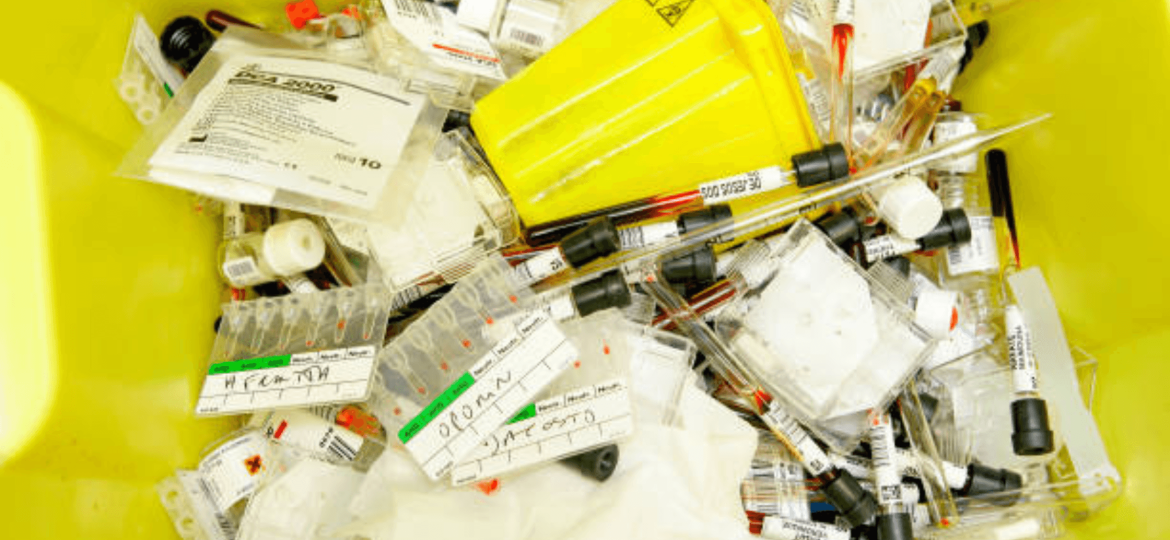
Mixed-use sites are the most common source of confusion. A hospital treats domestic sewage from wards and patient areas with an STP, but pathology labs, pharmacy effluent, and certain diagnostic discharges carry a chemical load that biological STP treatment isn’t designed to handle — that stream needs ETP-grade treatment instead. A factory needs an STP for canteen and toilet sewage, and a separate ETP for process-floor effluent. Hotels with heavy kitchen or laundry operations sometimes need ETP-grade pretreatment (a grease trap or DAF unit) ahead of the main STP if fat, oil, and grease loads are high enough to disrupt biological treatment.
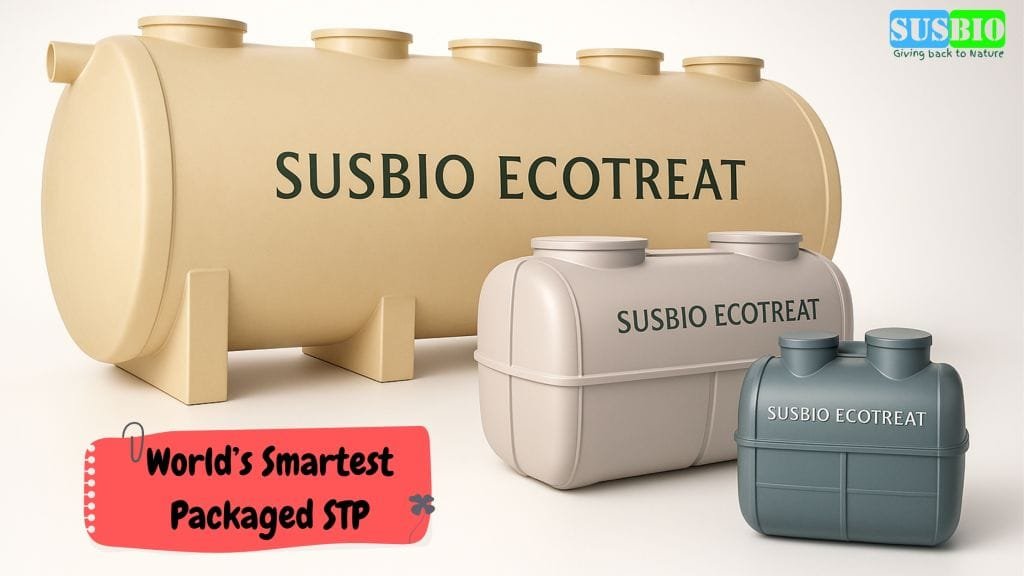
SUSBIO manufactures both sides of this split: ECOTREAT (Anaerobic + MBBR) for STP applications, and IONTREAT — an electrochemical ETP that reduces chemical consumption compared to conventional ETPs — for industrial effluent.
Choosing the Right Technology Within Each
On the STP side: MBBR handles the variable peak loads typical of residential occupancy (heavy mornings and evenings) with minimal operator skill. SBR delivers high treatment quality through timed batch cycles where tankage space allows. Anaerobic + MBBR — SUSBIO ECOTREAT’s approach — adds an anaerobic pre-treatment stage ahead of MBBR, reducing sludge generation and using up to 70% less electricity than conventional STPs.
On the ETP side: the right technology depends entirely on the contaminant profile, not on a general “best” option. Coagulation-flocculation and DAF handle suspended solids, oils, and color — common in textile and food/dairy effluent. Membrane filtration supports high-value water reuse where the economics justify it. Activated sludge or MBBR-based biological stages work for biologically degradable industrial organics. Advanced oxidation is reserved for recalcitrant compounds, common in pharmaceutical effluent.
Common Mistakes
- Treating industrial effluent with STP-grade biology alone. Biological systems aren’t built for chemical loads, heavy metals, or high salinity — they’ll fail or produce noncompliant discharge.
- Over-engineering domestic sewage as if it were industrial effluent. Office canteen or washroom sewage doesn’t need a chemical or membrane-based ETP train.
- Sizing for average flow instead of peak flow. Residential STPs need to handle morning and evening peaks, not just daily averages, or they under-treat during exactly the hours that matter.
- Skipping equalization ahead of batch-driven industrial discharges. A high-pH or high-chemical-load surge (e.g. from a cleaning-in-place cycle) without an equalization tank can shock and kill the biological stage downstream.
Frequently Asked Questions
Can one system handle both domestic sewage and industrial effluent?
Generally no. Combining the two streams dilutes and complicates treatment of both, and can violate discharge norms that require separate consent-to-operate categories. Best practice is parallel systems — an STP for domestic sewage, an ETP for process effluent — routed and monitored separately.
How do I know if my wastewater needs ETP-grade treatment?
If it originates from a manufacturing or industrial process — not from toilets, kitchens, or washbasins — and contains chemicals, dyes, oils, heavy metals, or unusually high COD/BOD, it needs ETP-grade treatment rather than a standard STP.
Is ETP always more complex than STP?
ETP design is typically more complex because it’s engineered around a specific contaminant profile rather than a standardized biological process. Exact scope and cost depend heavily on the specific contaminants, required removal efficiency, and discharge standards for that industry.
Can an STP be upgraded to handle light industrial effluent?
In some cases. If the industrial stream is dilute and primarily organic (some food-processing wastewater, for example), STP-based technology can be adapted with pretreatment like a grease trap or DAF unit. Chemically complex or high-COD streams still require true ETP treatment.
What technology does SUSBIO use for STP vs ETP?
SUSBIO ECOTREAT uses Anaerobic + MBBR technology for STP applications. SUSBIO IONTREAT is engineered for industrial ETP applications, using electrochemical treatment to reduce chemical consumption compared to conventional ETPs.
Do hotels and malls need STP, ETP, or both?
It depends on their wastewater sources. Guest room and office wastewater needs an STP. If on-site kitchens or laundry generate high-FOG or chemical-heavy effluent, a supplementary ETP-grade pretreatment stage may be needed alongside the STP.
Related reading:
- ETP vs STP: Key Differences and Applications — the full definitional breakdown this guide builds on
- SUSBIO ECOTREAT — our Anaerobic + MBBR packaged STP
- SUSBIO ETP / IONTREAT — our electrochemical ETP for industrial effluent
Industry-specific: