

The aeration tank gets most of the design attention, but the blower supplying it is just as decisive for whether an STP actually performs — and it’s the single largest energy consumer in most biological treatment systems. This guide covers how blowers are selected and sized, the trade-offs between blower types, and the mistakes that most commonly lead to underperforming or expensive-to-run systems.
For the tank design itself, see our companion guide on aeration tank design. This page focuses specifically on the equipment that supplies the oxygen.
Why Blower Selection Matters More Than It's Usually Given Credit For
Aeration typically accounts for a large share of an STP’s total energy consumption — often the single biggest line item in the plant’s operating cost. An undersized blower starves the biological process of oxygen, leading to poor treatment performance and the kind of foam and odor issues covered in our diagnostic guides. An oversized blower wastes energy continuously, every day the plant runs, for the life of the system. Getting this one component right has a bigger and more permanent impact on operating cost than almost any other design decision.
Blower Types Compared
Positive Displacement (Roots-type) Blowers: The traditional choice for smaller and mid-size STPs. Simple, robust, and tolerant of varying backpressure, but noisier and less energy-efficient than newer alternatives, with a pulsating airflow pattern.
Rotary Screw Blowers: Deliver smoother, more continuous airflow than Roots-type blowers, with better efficiency at partial loads. A common upgrade path for mid-to-large plants prioritizing energy savings over the lowest upfront cost.
Turbo (High-Speed Centrifugal) Blowers: The most energy-efficient option, using magnetic or air-bearing technology to eliminate friction losses. Higher upfront cost, but the efficiency gain can pay back over the system’s life, particularly for larger, continuously-running plants where energy cost dominates total operating expense.
How Blowers Are Sized
Blower sizing isn’t a single number — it’s derived from the oxygen demand the biological process actually needs, then converted into an airflow requirement accounting for real-world inefficiencies:
- Oxygen demand calculation: based on the BOD load entering the aeration stage — higher organic load requires proportionally more oxygen to break down.
- Standard Oxygen Transfer Efficiency (SOTE): diffusers don’t transfer 100% of supplied oxygen into the water — fine bubble diffusers typically achieve meaningfully higher transfer efficiency than coarse bubble systems, directly reducing the airflow (and blower size) needed for the same oxygen demand.
- Peak load, not average load: the same principle covered in our capacity guide — a blower sized only for average daily flow will be undersized during peak-hour organic loading, exactly when adequate oxygen transfer matters most.
- Altitude and temperature correction: air density affects actual oxygen delivery — sizing calculations need to account for site-specific conditions, not just sea-level standard assumptions.
Diffuser Type: The Other Half of the Equation
Blower sizing can’t be done in isolation from diffuser selection, since the two determine oxygen transfer efficiency together. Fine bubble diffusers (typically membrane-based) transfer oxygen substantially more efficiently than coarse bubble diffusers, meaning a correctly matched fine bubble system can often achieve the same oxygen delivery with a smaller, less energy-hungry blower — the efficiency gain compounds rather than existing as two separate improvements.
SUSBIO ECOTREAT's Approach to Aeration Efficiency
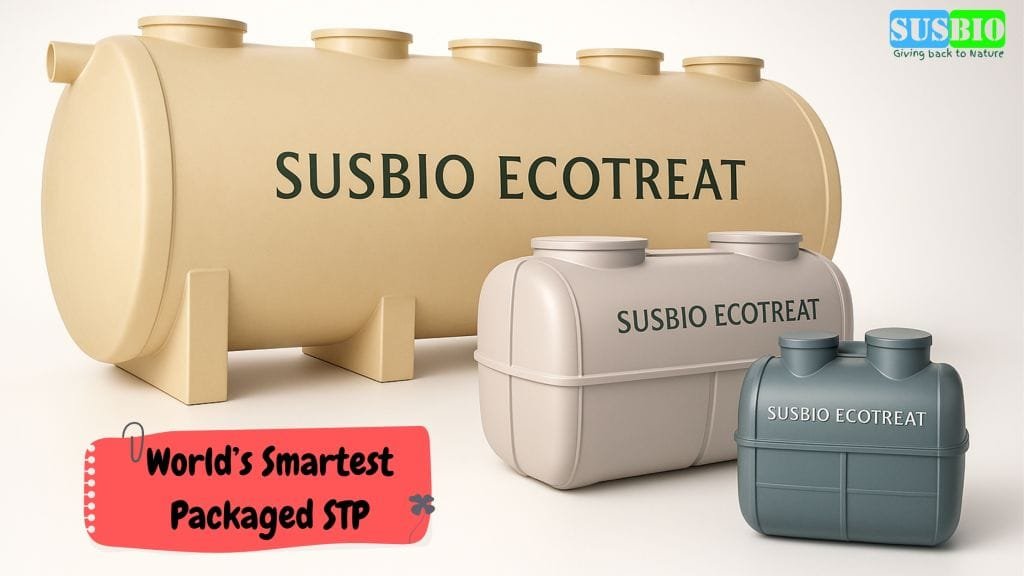
SUSBIO ECOTREAT’s Anaerobic + MBBR design reduces the aeration burden at the source: the anaerobic pre-treatment stage breaks down a significant share of organic load before it reaches the aerobic MBBR stage, meaning the blower serving that stage is sized against a genuinely lower oxygen demand than a conventional single-stage aerobic system treating the same influent. This is a structural contributor to ECOTREAT’s overall energy efficiency (up to 70% less electricity than conventional STPs) — not just a component-level optimization, but a process design that reduces how hard the blower has to work in the first place.
Common Mistakes
- Sizing for average flow rather than peak organic load. The same overload principle that affects tank sizing applies directly to blower sizing.
- Ignoring diffuser efficiency when selecting blower capacity. A blower sized for coarse bubble diffusers will be oversized (and inefficient) if fine bubble diffusers are used instead, or undersized in the reverse scenario.
- Selecting the lowest upfront-cost blower type without evaluating lifecycle energy cost. For a plant that runs continuously for years, the energy cost difference between blower types often dwarfs the upfront price difference.
- No provision for future capacity or load growth. Retrofitting blower capacity later is typically far more disruptive than accounting for reasonable growth at the design stage.
Frequently Asked Questions
How much of an STP’s energy consumption comes from the blower?
Aeration typically accounts for a large share of total plant energy use, often the single biggest operating cost line item in a biological treatment system.
What’s the difference between positive displacement and turbo blowers?
Positive displacement (Roots-type) blowers are simpler and more tolerant of backpressure variation but less energy-efficient. Turbo blowers use magnetic or air-bearing technology for higher efficiency, at a higher upfront cost, typically justified for larger or continuously-running systems.
Why does diffuser type affect blower sizing?
Diffuser type determines oxygen transfer efficiency. Fine bubble diffusers transfer oxygen more efficiently than coarse bubble systems, which can allow a smaller blower to deliver the same effective oxygen supply.
Should a blower be sized for average or peak load?
Peak load. A blower sized only for average daily flow will be undersized during peak-hour organic loading, exactly when oxygen demand is highest and adequate aeration matters most.
How does SUSBIO ECOTREAT reduce blower energy requirements?
The Anaerobic + MBBR process breaks down a significant share of organic load in the anaerobic pre-treatment stage before it reaches the aerobic MBBR stage, reducing the oxygen demand — and therefore the blower capacity and energy consumption — needed at the aeration stage itself.
Conclusion
Blower selection and sizing is a bigger lever on an STP’s long-term operating cost than its relatively low profile in most project discussions would suggest — it’s typically the single largest energy consumer in the entire system. Getting oxygen demand, diffuser efficiency, and peak-load sizing right at the design stage avoids both the underperformance of an undersized system and the permanent energy waste of an oversized one. SUSBIO ECOTREAT’s Anaerobic + MBBR process addresses this at a more fundamental level — reducing the oxygen demand itself, not just optimizing the equipment that meets it.
Note: General blower engineering content (types, SOTE, diffuser efficiency, oxygen demand sizing) is standard wastewater engineering knowledge, not fabricated. No specific numeric efficiency percentages were asserted for blower types beyond established general comparisons, since exact figures vary meaningfully by manufacturer and model — worth adding real SUSBIO-specific blower spec data if available, which would strengthen this page’s differentiation further.